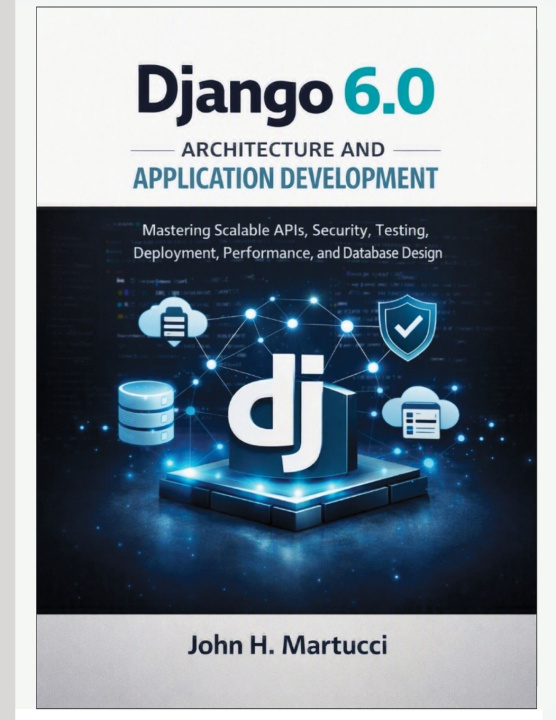
Have you ever inherited a Django project and spent your first week just trying to figure out why it works the way it does?
If you've built more than one Django application, you already know the tutorials only get you so far. They show you how to make something run. They rarely show you how to make something last - how to structure a codebase so it's still sane two years and three developers later, how to catch a slow query before it becomes a 2 a.m. incident, or how to ship a schema change without taking your application offline.
This book was written for the point in a developer's career where "it works" stops being good enough.
What's actually inside
Rather than walking through Django's features one by one, this book follows the real lifecycle of a production application - from the architectural decisions you make before writing a single model, through to the operational realities of running that application at scale.
You'll work through:
- Structuring a Django project around genuine business domains, not technical categories that fall apart under pressure
- Designing databases that hold up under real traffic - indexing strategy, query optimization, and the difference between normalization in theory and normalization that actually ships
- Building REST and GraphQL APIs meant to be consumed by more than one client, versioned in a way that doesn't punish you for improving them later
- Implementing authentication and authorization that doesn't quietly become a liability - JWTs, OAuth2, role-based and attribute-based access control, done properly
- Writing a test suite your team can actually trust, instead of one that reports high coverage while verifying almost nothing
- Deploying with zero downtime, using containers and orchestration in a way that's explained clearly enough to actually reason about, not just copy
- Recognizing where asynchronous processing genuinely helps - and where it just adds complexity you didn't need
Who this is for
You should already be comfortable with the basics - models, views, templates, migrations. This isn't a first book on the framework. It's the second one: written for developers who've shipped something, felt the friction of a decision they didn't fully think through, and want to understand why certain patterns hold up while others quietly become technical debt.
Why this approach, and not another feature walkthrough?
Because most of the mistakes that hurt a production system aren't caused by not knowing a method exists. They're caused by not understanding the tradeoff behind using it. Every chapter in this book pairs a technique with the reasoning behind it - including the honest costs, not just the benefits - so you're making informed architectural decisions instead of copying a pattern you don't fully trust.
Every code example reflects realistic, occasionally messy production conditions: concurrent writes, third-party API failures, data that doesn't arrive the way you'd hoped. Case studies throughout the book walk through actual engineering decisions - auditing a legacy codebase, refactoring a slow reporting pipeline, scaling a platform from a thousand users to well over a million - including the missteps along the way, not just the tidy final answer.
A book meant to be returned to
Read it start to finish if you're building something new. Or keep it nearby and pull it off the shelf when you hit a specific wall - an N+1 query you can't quite trace, a deployment that needs to happen without downtime, a permissions model that's starting to feel fragile. Either way, you'll find something built to be used, not just read once.
If you're ready to build backend systems you can genuinely stand behind - not just ones that happen to work today - this book is for you.