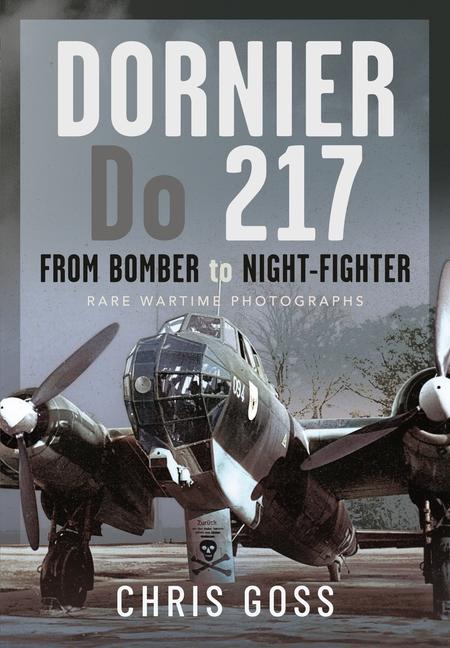
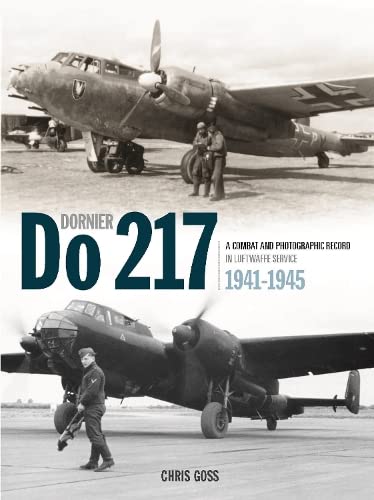
Entering service in early 1941, the Dornier Do 217 was designed as an improved version of the ‘Flying Pencil’, the Do 17 bomber. The Do 217E-1 twin radial-engine bomber first flew in October 1940, the same month that the production of the Do 17 ceased. The Do 217 was initially used for conventional bombing and anti-shipping missions around the United Kingdom, including the infamous Baedeker Blitz against British provincial cities in 1942\. The Do 217 was the main German bomber in this theatre until late 1943, when it started to be replaced by the Messerschmitt Me 410 and Junkers Ju 188\. During this period, the Do 217E was improved, leading to the introduction of the Do 217K or M, the difference between the two being the engines. The Do 217 would be deployed in all of the Luftwaffe’s campaigns and fronts in the Second World War. Curiously, though, the only operational units to use the type on the Eastern Front were the night reconnaissance units, aside from which only occasionally did other Do 217 units fly missions against Stalin’s forces. With the delay in the Heinkel He 177 entering service, it was the Do 217 that became the first aircraft in history to be used to deploy precision-guided weapons in combat. This came on 21 July 1943, when Do 217s of KG 100 attacked Allied shipping in Augusta harbour, Sicily, using Fritz X radio-guided glide bombs. Then, on 25 August 1943 twelve Do 217E-5s from II./KG 100 attacked a convoy off the Spanish coast with a similar weapon to the Fritz X, the Henschel Hs 293 radio-guided glide bomb. This attack resulted in damage to three warships. In response to the intensifying Allied strategic bomber offensive, additional night fighters were needed by the Luftwaffe. The Do 217E-2 was therefore modified by fitting four MG17s and four MG-FF 20mm cannon in a solid nose. The rear firing guns, including the MG131 in the turret, were retained, as was the ability to carry bombs, creating the Do 217J-1 which was intended as a night intruder. The Do 217 also served extensively as a night fighter, with examples being fitted with Lichtenstein radar and obliquely mounted upward-firing MG151 cannon in the fuselage, the so called Schräge Musik modification. Despite the Do 217’s versatility and wide-spread deployment – all of which is explored here by the author through a remarkable set of archive images, many of which have never been seen in print before – production ceased in October 1943\. By the following year, the Do 217 had become obsolete.