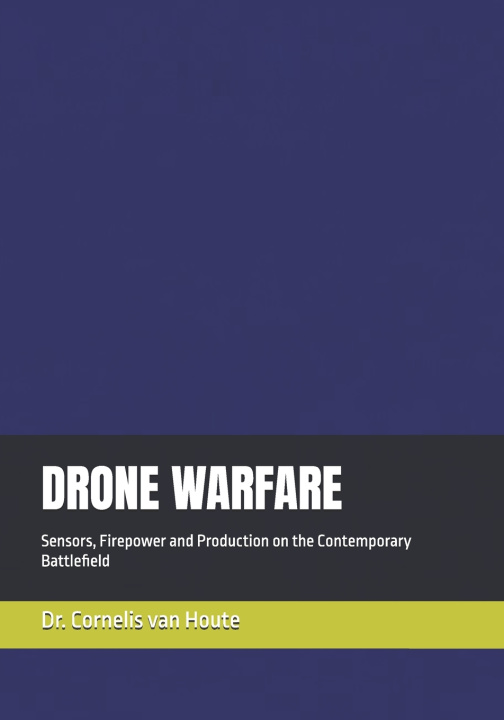
Between 2022 and 2026, two industrial states fought a war in which unmanned systems became the proximate cause of most battlefield casualties. What that means has been asserted far more often than it has been measured.
Drone Warfare examines the claim rather than repeating it. Across fifty-eight chapters it traces how sensors, firepower and production interact on a battlefield where concentration of force is punished, where the electromagnetic spectrum determines tactical outcomes, and where the most effective answer to the most sophisticated jamming ever fielded turned out to be a glass thread on a spool.
The book is built on primary research. The author conducted three field studies in Ukraine - at Bakhmut, Avdiivka and Pokrovsk - comprising 2,562 recorded artillery engagements, together with interviews with battery commanders and unmanned systems operators. These measure a quantity the analytical literature repeats without a primary source: rounds expended per target neutralised, with and without continuous airborne observation. The results are reported with their confidence intervals, their effect sizes, their limitations, and two corrections the author found in his own calculations.
The findings are not what the public argument assumes. Drones did not replace artillery; they made it roughly an order of magnitude less wasteful, and the standardised effect proved stable across three sectors, three seasons and three electromagnetic environments. The control condition, included only as a baseline, revealed something the design had not sought: the artillery arm itself became measurably more precise over the war, independently of anything drones did.
Each chapter states one falsifiable proposition, sets out the strongest objection to it, and assigns a stated confidence - from high down to three cases where the evidence supports no conclusion in either direction. Every quantity is labelled by category and by the interest of its source, and belligerent claims receive identical scepticism. Chapter 2 makes the strongest case against the book without rebuttal; Chapter 58 lists the six conditions under which that case would win, together with the eighteen weakest claims the book contains.
Nine appendices supply reference material: drone taxonomy, order of battle for unmanned formations, comparative specifications, cost-per-effect tables, production estimates with confidence grades, a timeline from 2000 to 2026, a glossary, and a register of disputed figures and unresolved questions.
Written for military officers, defence analysts, intelligence professionals, military historians and policymakers. It contains no classified material, offers no procurement recommendations, and states plainly where the evidence runs out.
Dr. Cornelis van Houte, former Navy servicemember, is a military consultant.