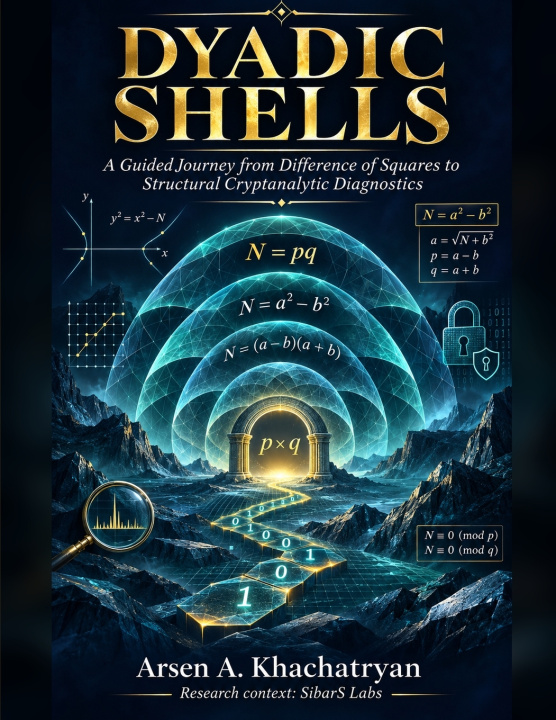
What can the hidden arithmetic structure of a composite number tell us before we know its prime factors?
Dyadic Shells explores this question through a carefully structured journey from classical number theory to modern computational cryptography.
Beginning with the difference-of-squares method of Fermat and Kraitchik, the book introduces dyadic representations, two-adic valuations, the Chinese Remainder Theorem, algebraic restrictions on factor searches, and public structural diagnostics for semiprime numbers.
Building on these foundations, readers discover how mathematical structure can guide conditional factor searches-and why even mathematically correct screening methods may fail to uncover unknown factors.
Inside this book, you will explore:
Classical factorization identities and their geometric interpretation.
Two-adic arithmetic, CRT branches, and structural obstructions.
Quadratic-residue sieves, exact local counts, and saturation limits.
Sparse-center representations, anchored offsets, and conditional search algorithms.
Lattice-based methods, meet-in-the-middle techniques, and computational cost models.
Experimental RSA-modulus audits, planted positive controls, and reproducible research.
Python laboratories, QR-linked source code, and formal verification with Lean 4.
The course combines mathematical reasoning with worked examples, computational exercises, research references, and direct access to supporting software.
Based on the author's Dyadic Shells research program, developed in the context of SibarS Labs, the book distinguishes established mathematics, independently checkable proofs, experimental observations, and open research questions.
This is not a claim of a universal RSA-breaking algorithm. It is a rigorous exploration of when structural information may improve cryptanalytic diagnostics, when it cannot, and how such claims should be tested.
Written for students of mathematics and computer science, cybersecurity professionals, and researchers interested in computational number theory, Dyadic Shells offers a practical framework for connecting mathematical theory with reproducible experimentation.
Discover the structure. Understand the limitations. Verify the results.