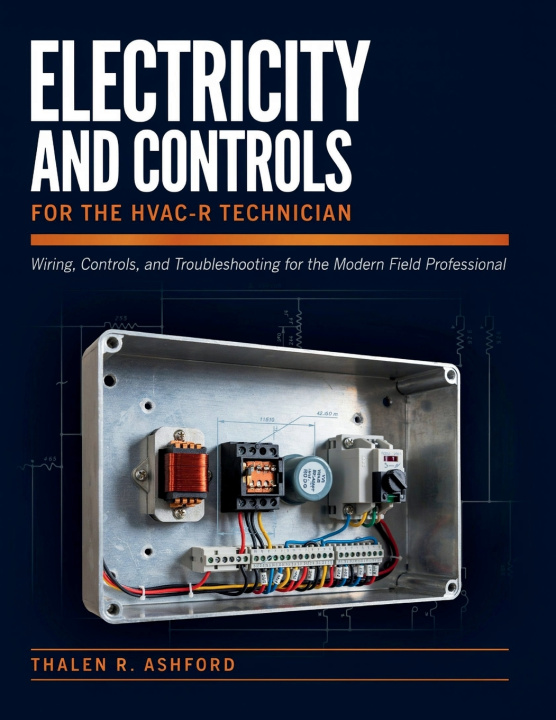
Every technician carries a multimeter. Not every technician knows what to do with the reading.
This book changes that.
Electricity and Controls for the HVAC-R Technician builds complete electrical knowledge from the ground up - starting with zero assumed background and arriving at the diagnostic confidence a working professional needs on every service call. Whether you are an apprentice picking up a meter for the first time or a journeyman filling gaps that years of experience left behind, this book meets you where you are and takes you further than you expected to go.
The electrical principles are taught the way the field actually works - physical scenario first, concept second, equation third, application fourth. Every formula is anchored to something you can measure on a real system. Every component is explained not just by what it does, but by what it looks like when it fails and exactly how to test it.
What this book covers:
Electrical fundamentals, circuits, and AC theory built from first principles - without unnecessary mathematics. Single-phase and three-phase services, wire sizing, NEC Article 440 compliance, LOTO, and arc flash awareness. Test instrument mastery - multimeter, clamp meter, and megohmmeter with pass/fail criteria for every test. Transformers, all HVAC-R motor types including ECM and brushless DC, and every starting component a technician encounters. Compressor electrical systems - terminal identification, winding resistance testing, ground fault testing, internal overload behavior, three-phase phase balance, and scroll compressor rotation verification. Control components, sensing devices, wiring diagrams, and control circuit development. Variable-speed technology - VFDs, ECM control modes, inverter-driven compressors, and mini-split electrical diagnosis. Gas and oil burner controls, defrost circuits, and communicating thermostat systems. A complete troubleshooting methodology - the five-step process, hopscotch method, half-split method, and eight fully worked service calls drawn from residential, commercial, and variable-speed systems.
Every concept is immediately followed by its field consequence. Every test procedure states the expected reading, what a wrong reading means, and what to do next. Every worked service call shows the diagnostic reasoning from first symptom to confirmed fault.
This is the electrical reference built for the HVAC-R professional - from the first day on the job to the thirtieth year.