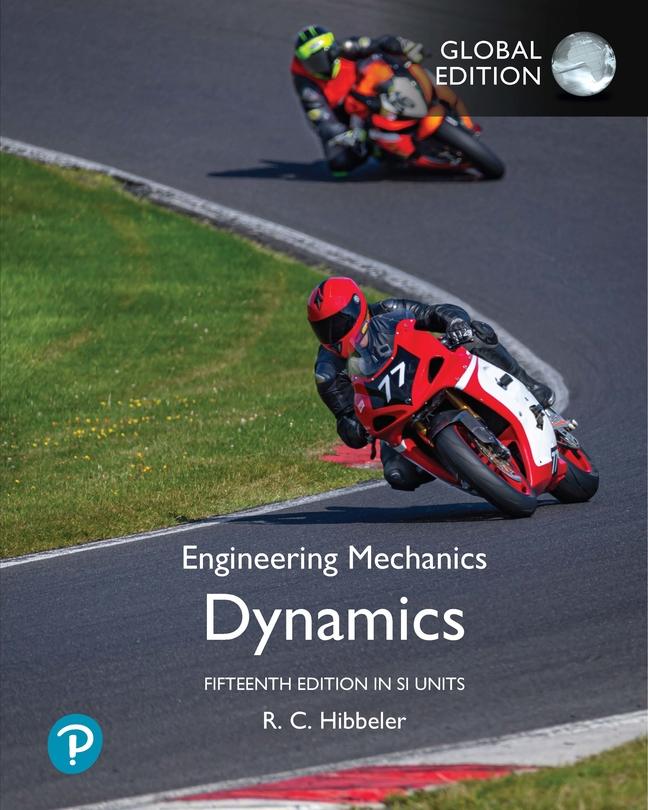
KEY MESSAGE: Engineering Mechanics: Statics excels in providing a clear and thorough presentation of the theory and application of engineering mechanics. Engineering Mechanics empowers students to succeed by drawing upon Hibbeler's everyday classroom experience and his knowledge of how students learn. This text is shaped by the comments and suggestions of hundreds of reviewers in the teaching profession, as well as many of the author's students.
The Fourteenth Edition includes new Preliminary Problems, which are intended to help students develop conceptual understanding and build problem-solving skills. The text features a large variety of problems from a broad range of engineering disciplines, stressing practical, realistic situations encountered in professional practice, and having varying levels of difficulty.
More info on: http://www.pearsonhighered.com/hibbeler-14e-info/index.html
Improve Results with MasteringEngineering
MasteringEngineering is an online homework, tutorial, and assessment program designed to work with this text to engage students and improve results. Interactive, self-paced tutorials provide individualized coaching to help students stay on track. With a wide range of activities available, students can actively learn, understand, and retain even the most difficult concepts.The text and MasteringEngineering work together to guide students through engineering concepts with a multi-step approach to problems.
KEY TOPICS: General Principles; Mechanics; Fundamental Concepts; Units of Measurement; The International System of Units; Numerical Calculations; General Procedure for Analysis; Force Vectors; Chapter Objectives; Scalars and Vectors; Vector Operations; Vector Addition of Forces; Addition of a System of Coplanar Forces; Cartesian Vectors; Addition of Cartesian Vectors; Position Vectors; Force Vector Directed Along a Line; Dot Product; Equilibrium of a Particle; Chapter Objectives; Condition for the Equilibrium of a Particle; The Free-Body Diagram; Coplanar Force Systems; Three-Dimensional Force Systems; Force System Resultants; Chapter Objectives; Moment of a ForceScalar Formulation; Cross Product; Moment of a ForceVector Formulation; Principle of Moments; Moment of a Force about a Specified Axis; Moment of a Couple; Simplification of a Force and Couple System; Further Simplification of a Force and Couple System; Reduction of a Simple Distributed Loading; Equilibrium of a Rigid Body; Chapter Objectives; Conditions for Rigid-Body Equilibrium; Free-Body Diagrams; Equations of Equilibrium; Two- and Three-Force Members; Free-Body Diagrams; Equations of Equilibrium; Constraints and Statical Determinacy; Structural Analysis; Chapter Objectives; Simple Trusses; The Method of Joints; Zero-Force Members; The Method of Sections; Space Trusses; Frames and Machines; Internal Forces; Internal Loadings Developed in Structural Members; Shear and Moment Equations and Diagrams; Relations between Distributed Load, Shear, and Moment; Cables; Friction; Characteristics of Dry Friction; Problems Involving Dry Friction; Wedges; Frictional Forces on Screws; Frictional Forces on Flat Belts; Frictional Forces on Collar Bearings, Pivot Bearings, and Disks; Frictional Forces on Journal Bearings; Rolling Resistance; Center of Gravity and Centroid; Center of Gravity, Center of Mass, and the Centroid of a Body; Composite Bodies; Theorems of Pappus and Guldinus ;Resultant of a General Distributed Loading; Fluid Pressure; Moments of Inertia; Definition of Moments of Inertia for