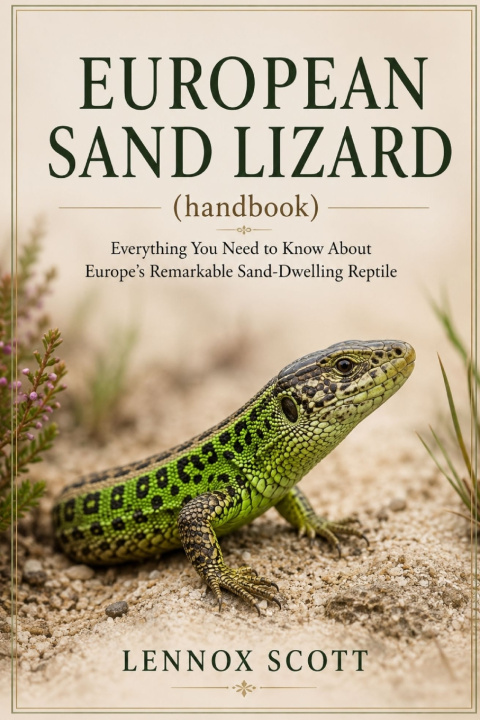
The European Sand Lizard Handbook provides a comprehensive exploration of the European sand lizard (Lacerta agilis), one of Europe's most recognizable and ecologically important reptiles. Covering every aspect of the species' biology, ecology, and conservation, the handbook serves as an authoritative guide for wildlife enthusiasts, students, researchers, educators, and conservationists.
The book begins by introducing the taxonomy, evolutionary history, and physical characteristics of the European sand lizard, highlighting its distinctive seasonal coloration, sexual dimorphism, and adaptations for life in sunny, open habitats. It examines the species' geographic distribution across Europe and parts of Asia, emphasizing the importance of heathlands, coastal dunes, grasslands, and woodland edges for its survival.
Readers gain an in-depth understanding of the sand lizard's daily behavior, thermoregulation, territorial interactions, communication, and feeding ecology. The handbook explains how the species relies on external heat sources to regulate body temperature and how its diverse diet of insects and other invertebrates supports both its own survival and the ecological balance of its habitats.
The reproductive cycle is explored from courtship and mating through egg laying, incubation, hatching, juvenile development, and adulthood. The book also details the many predators and environmental threats faced by the species, including habitat loss, climate change, pollution, invasive species, and human disturbance, while examining the remarkable defense mechanisms-such as camouflage, rapid escape, and tail autotomy-that have evolved to improve survival.
Beyond biology, the handbook emphasizes the European sand lizard's ecological importance as both predator and prey, its role as an indicator of healthy ecosystems, and its contribution to maintaining biodiversity. It explains the legal protections afforded to the species across much of its range and highlights successful conservation initiatives involving habitat restoration, captive breeding, scientific monitoring, and public participation.
The guide also encourages ethical wildlife watching, responsible photography, and citizen science, demonstrating how individuals can contribute meaningfully to conservation efforts. Common myths are dispelled through scientific evidence, fostering a greater appreciation for reptiles and their ecological value.
Concluding with practical conservation guidance and a forward-looking perspective, The European Sand Lizard Handbook underscores the importance of protecting habitats, supporting biodiversity, and promoting environmental stewardship. It reminds readers that conserving the European sand lizard also safeguards the rich ecosystems upon which countless other species depend, ensuring that this remarkable reptile continues to thrive for generations to come.