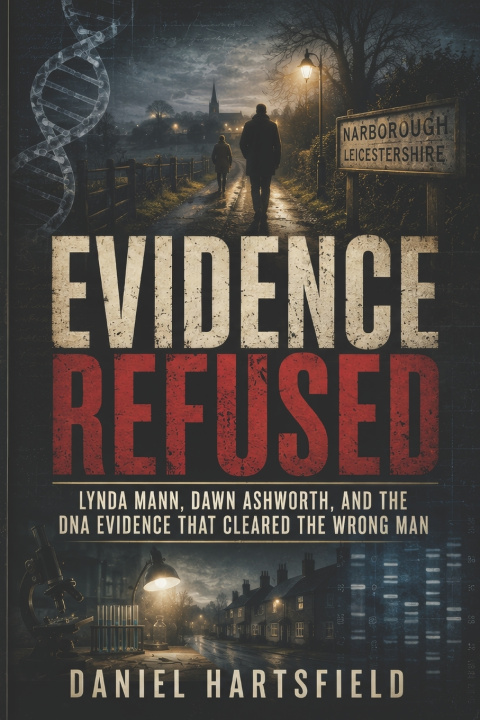
A landmark true crime case where DNA evidence first said no.
Evidence Refused is an evidence-aware true crime account of the murders of Lynda Mann and Dawn Ashworth, the wrongful suspicion of Richard Buckland, and the forensic investigation that identified Colin Pitchfork after an attempted sample deception.
In 1983, Lynda Mann, 15, was murdered in the Narborough area before DNA fingerprinting had entered criminal investigation. In 1986, Dawn Ashworth, also 15, disappeared after leaving a friend's house. Her murder reopened the earlier unanswered case and pushed investigators toward a new kind of forensic proof.
The first apparent answer was not the right one. Richard Buckland confessed during the investigation into Dawn's murder, later withdrew the confession, and was charged. DNA testing contradicted that path: biological material from both murders was linked to the same male source, but Buckland was excluded. Before DNA helped identify the convicted offender, it protected a wrongly implicated young man.
The search then moved into the surrounding community through a mass DNA screening of local men. The method was powerful, but it depended on truthful identity. Colin Pitchfork avoided the dragnet by arranging for another man to give a sample in his place. A reported pub conversation helped expose the substitution, leading investigators back to the man whose true sample had been missing.
Pitchfork pleaded guilty in January 1988 to the murders and rapes of Lynda Mann and Dawn Ashworth, along with related offences. The case became a landmark in forensic DNA history, but this account keeps the human story at the center: two girls whose lives were taken, a cleared former suspect, a community drawn into a new investigative process, and a legal afterlife that continued through parole, release, recall, and refusal.
Written as restrained narrative nonfiction, Evidence Refused avoids invented dialogue and unnecessary graphic detail. It follows public records, legal summaries, scientific history, and credible reporting while distinguishing confirmed fact, reported information, disputed material, and the limits of what the public record can safely reconstruct.
For readers interested in true crime, forensic science, DNA evidence, wrongful suspicion, false confession, and British criminal justice history, this book examines not only how DNA identified a convicted man, but how evidence can protect the innocent before it accuses the guilty.