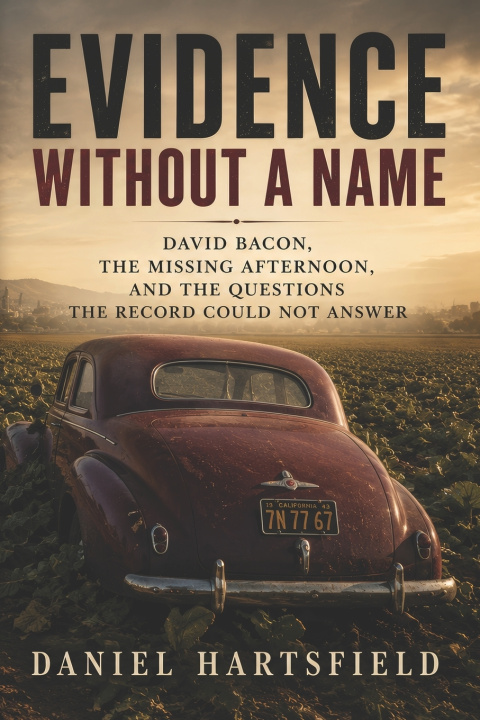
A bloodied car. A missing afternoon. An unsolved 1943 Hollywood homicide-and no legally established name.
On September 12, 1943, stage and film actor David Bacon-born Gaspar Griswold Bacon Jr.-was found fatally wounded after his small maroon automobile left Washington Boulevard and entered a Los Angeles bean field. He survived long enough to ask for help, but not long enough to identify the person responsible. No one is known from the reviewed record to have been charged, tried, or convicted for his death.
Evidence Without a Name is a historical true crime investigation of the hours that vanished before Bacon's final public moments and the physical evidence that remained afterward. Rather than forcing a solution onto an incomplete record, Daniel Hartsfield reconstructs the case through documented facts, contemporary reporting, archival material, witness accounts, and carefully marked uncertainty.
The narrative begins before the homicide, restoring the man behind the case: his prominent Massachusetts family, Harvard theatrical work, adoption of the professional name David Bacon, modest Hollywood career, and marriage to singer Greta Keller. It then follows the conflicting departure times, the reported plan to swim, the erratic car on Washington Boulevard, and the roadside plea that became the human center of the investigation.
Inside and around the car, investigators encountered clues that created pressure without producing identity: blood inside the vehicle, a reported narrow-blade wound, valuables that complicated a simple robbery theory, a sweater treated as potentially significant, and a bloodied garment whose meaning remained uncertain. Beyond the vehicle were a separately rented cottage, a coded diary without a publicly available decoding, conflicting descriptions of possible companions, and names that entered the investigation without becoming a prosecutable case.
The book also examines what happened after the evidence stopped speaking clearly. A false blackmail account, an unreliable statement, and later celebrity-centered theories offered dramatic explanations that the surviving record could not support. By tracing how repetition can turn rumor into inherited "fact," the book asks a larger question: what does responsible true crime require when the victim is known, the homicide is real, and the assailant remains unidentified?
Written in a restrained, evidence-conscious style, this narrative nonfiction account separates confirmed fact, reported information, allegation, interpretation, and speculation. A detailed timeline, key-people glossary, and source index help readers follow the case while preserving the limits of what can honestly be claimed.
For readers drawn to historical true crime, unsolved Hollywood cases, cold case evidence, and public-record investigations, Evidence Without a Name offers not a manufactured verdict, but a careful reckoning with what remains.