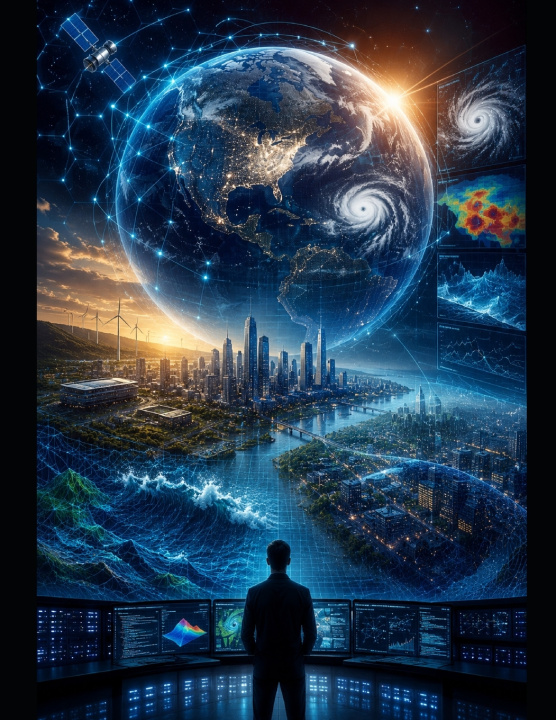
What happens after the prediction is made?
A storm has been forecast.
A flood has been simulated.
A cascading infrastructure failure has been identified.
Now comes the hardest part:
The decision.
In this final volume of the Synthetic Reality Series, the focus shifts from understanding reality and predicting reality to acting upon reality. Here, Digital Twins evolve from scientific instruments into operational systems capable of supporting critical decisions during moments of uncertainty, crisis, and systemic risk.
Drawing upon graph theory, infrastructure modeling, power system analysis, agent-based simulation, optimization, and decision intelligence, this volume explores how interconnected systems respond to disruption-and how resilience can be engineered before catastrophe strikes.
Inside, you will explore:
Graph Theory for Critical Infrastructure
Power Flow Physics and Cascading Failures
Multi-Physics Coupling and System Interdependencies
Agent-Based Modeling for Evacuation and Human Behavior
Infrastructure Resilience and Risk Assessment
Digital Twin Decision Architectures
Optimization Under Uncertainty
Algorithmic Governance and Ethical Decision Systems
The Future of Intelligent Crisis Management
Bridging engineering, computation, policy, and ethics, this volume reveals how next-generation Digital Twins can help societies anticipate disruptions, allocate resources, manage crises, and strengthen resilience across increasingly complex networks.
As infrastructure becomes more connected and risks become more systemic, the ability to make informed decisions may become the most important engineering challenge of the twenty-first century.
The future will not be defined by what we know.
It will be defined by what we choose to do with that knowledge.
Welcome to the Decision Layer.
Welcome to the frontier of Resilient Reality.