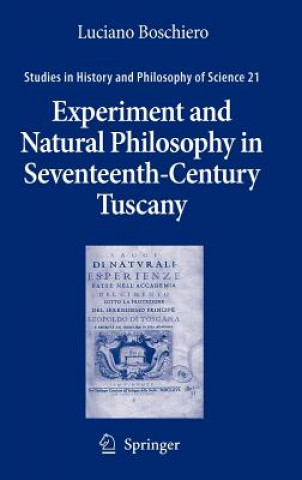
The Accademia del Cimento (1657-1667) was the first institution in Europe purporting to use an experimental method in its scientific inquiries. According to some recent accounts, the Cimento belonged to a new culture of knowledge making that abandoned the practice of constructing theories in favour of a programme that simply accumulated matters of fact , free from theoretical arguments and speculations.§However, while the Cimento, led by Tuscany s Prince Leopoldo de Medici, created a persuasive experimental rhetoric, in actuality the academicians continued to construct experiments and interpret their results on the basis of their theoretical aims and their broader interests in natural philosophy.§This analysis begins by examining the use of experiments, mathematics, and natural philosophy in seventeenth-century Italy. Once these topics are clearly defined, it becomes easier to understand the intellectual interests and motivations of each of the Cimento s members. Case studies regarding the Cimento s work on air-pressure, the vacuum, the freezing process, and the properties and effects of heat and cold, reveal the group s natural philosophical skills, commitments, and agendas. Meanwhile, in an attempt to avoid religious pressure and to maintain an uncontroversial reputation for the academy, Leopoldo censored the academicians from publicly expressing their views on a number of issues.§The purpose of this work is to counter historiographies that search for the origins of modern science within the experimental practices of Europe s first scientific institutions, such as the Cimento. It proposes that we should look beyond the experimental rhetoric found in published works, to find that the Cimento academicians were participants in a culture of natural philosophical theorising that existed throughout Europe.This work counters historiographies that search for the origins of modern science within the experimental practices of Europe s first scientific institutions, such as the Cimento. It proposes that we should look beyond the experimental rhetoric found in published works, to find that the Cimento academicians were participants in a culture of natural philosophical theorising that existed throughout Europe.The Accademia del Cimento (1657-1667) was the first institution in Europe purporting to use an experimental method in its scientific inquiries. According to some recent accounts, the Cimento belonged to a new culture of knowledge making that abandoned the practice of constructing theories in favour of a programme that simply accumulated matters of fact , free from theoretical arguments and speculations. §However, while the Cimento, led by Tuscany s Prince Leopoldo de Medici, created a persuasive experimental rhetoric, in actuality the academicians continued to construct experiments and interpret their results on the basis of their theoretical aims and their broader interests in natural philosophy.§This analysis begins by examining the use of experiments, mathematics, and natural philosophy in seventeenth-century Italy. Once these topics are clearly defined, it becomes easier to understand the intellectual interests and motivations of each of the Cimento s members. Case studies regarding the Cimento s work on air-pressure, the vacuum, the freezing process, and the properties and effects of heat and cold, reveal the group s natural philosophical skills, commitments, and agendas. Meanwhile, in an attempt to avoid religious pressure and to maintain an uncontroversial reputation for the academy, Leopoldo censored the academicians from publicly expressing their views on a number of issues.§The purpose of this work is to counter historiographies that search for the origins of modern science within the experimental practices of Europe s first scientific institutions, such as the Cimento. It proposes that we should look beyond the experimental rhetoric found in published works, to find that the Cimento academicians were participants in a culture of natural philosophical theorising that existed throughout Europe.