Bridge the Gap Between Robotics Research and Real-World Deployment
Every major AI lab-from Google DeepMind and NVIDIA to Physical Intelligence and Figure AI-has launched production robotics foundation model programs. Yet, the engineering knowledge needed to build, train, and deploy these complex systems in the real world remains locked behind academic papers. Foundation Models for Robotics is the definitive, practical guide designed to bridge this gap for machine learning practitioners and robotics engineers.
Written specifically for working engineers rather than academic researchers, this book moves past theoretical proofs to deliver the practical architectural intuitions, crucial engineering trade-offs, and deployment strategies required to build intelligent autonomous agents.
What You Will Master Inside:
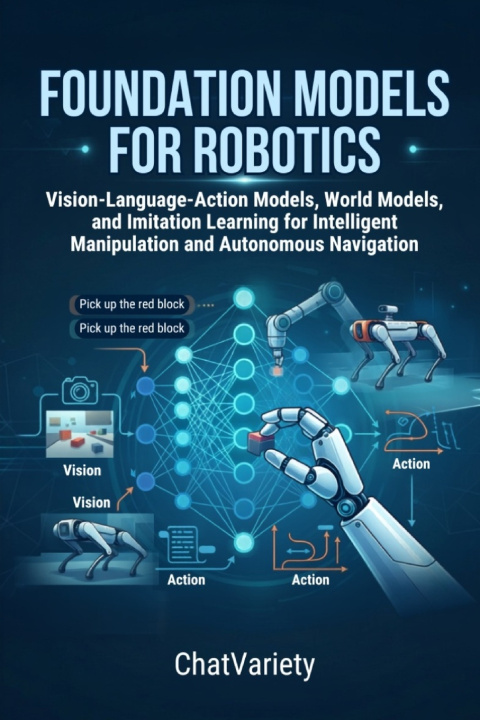
- VLA Architectures: How to integrate vision, language, and action into unified differentiable models.
- Action Representations: Navigate the trade-offs between discrete tokens, diffusion policies, and flow matching for smooth control.
- Data Engineering & Imitation Learning: Scalable strategies for teleoperation, simulation, cross-embodiment datasets, and overcoming distributional drift.
- World Models & Navigation: Leverage predictive models for long-horizon planning and spatial understanding.
- Hardware Deployment: Optimize large VLA models for edge inference, ROS2 integration, tactile sensing, and safety-critical environments.
Whether you are designing fine motor controls for dexterous manipulation, deploying reinforcement learning pipelines, or tackling full-body control challenges for humanoid robots, this guide provides the production-ready insights you need to lead the next wave of Embodied AI.