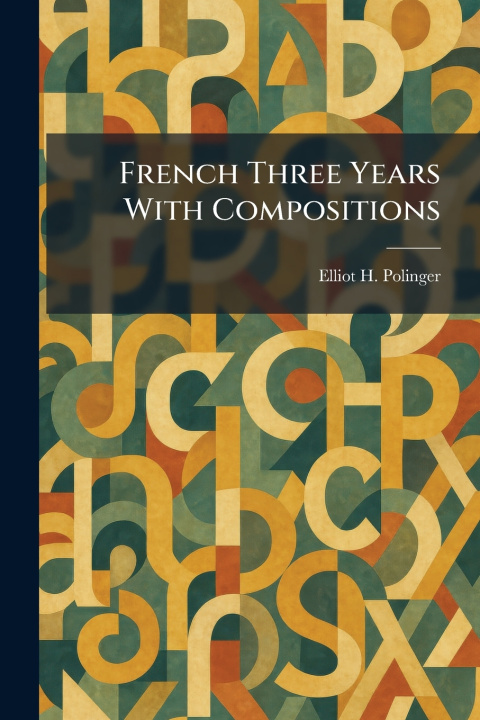
"French Three Years With Compositions" is a comprehensive pedagogical resource designed to facilitate advanced proficiency in the French language. Authored by Elliot H. Polinger, this instructional work serves as a rigorous guide for students entering their third year of French study, emphasizing both linguistic structure and the art of written expression.
The volume focuses heavily on the development of composition skills, providing students with the tools necessary to synthesize grammar, vocabulary, and syntax into cohesive narrative and expository forms. By bridging the gap between foundational language skills and sophisticated communication, the text offers a structured approach to mastering complex verb tenses, idiomatic expressions, and stylistic nuances unique to the French tongue.
Historical in its approach to language education, "French Three Years With Compositions" reflects the academic standards and pedagogical methodologies of the early 20th century. It remains a valuable reference for educators and linguists interested in the evolution of foreign language instruction and the traditional methods used to cultivate fluency. The book's systematic lessons and practice exercises provide a clear roadmap for learners seeking to refine their literary and analytical capabilities in French.
This work has been selected by scholars as being culturally important, and is part of the knowledge base of civilization as we know it. This work was reproduced from the original artifact, and remains as true to the original work as possible. Therefore, you may see the original copyright references, library stamps (as most of these works have been housed in our most important libraries around the world), and other notations in the work.
This work is in the public domain in the United States of America, and possibly other nations. Within the United States, you may freely copy and distribute this work, as no entity (individual or corporate) has a copyright on the body of the work.
As a reproduction of a historical artifact, this work may contain missing or blurred pages, poor pictures, errant marks, etc. Scholars believe, and we concur, that this work is important enough to be preserved, reproduced, and made generally available to the public. We appreciate your support of the preservation process, and thank you for being an important part of keeping this knowledge alive and relevant.