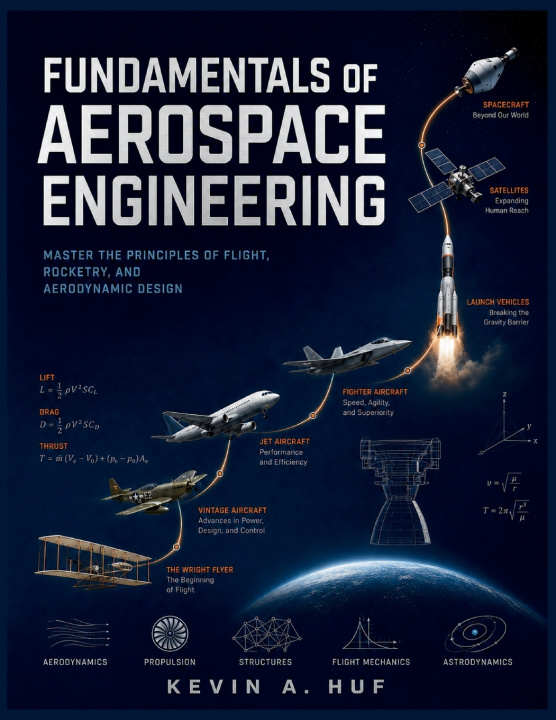
Aerospace engineering asks one unforgiving question of every vehicle: will the forces balance? A wing must lift the weight it carries, an engine must produce more thrust than the airframe creates in drag, and a structure must survive every load without exceeding what the material can bear - all at minimum weight.
Most students meet this discipline through a stack of separate courses and textbooks - one for aerodynamics, another for propulsion, another for structures, another for orbital mechanics - each with its own notation and its own starting assumptions. The result is often a fragmented understanding, where a formula gets applied outside the regime it was derived for, or a result from one chapter never connects to the vehicle-level trade-offs it was meant to inform.
This engineering guide treats aerospace engineering as one connected argument, built in a single direction from the atmosphere upward to orbit. Every major equation is derived from stated assumptions before it is applied, and every result is labeled with the flight regime in which it holds.
What you will learn
- How the standard atmosphere, fluid conservation laws, and dimensional analysis form the working environment every later calculation depends on.
- How lift, drag, and moment arise from first principles, from airfoil and thin-wing theory through finite-wing effects and compressible, high-speed flow.
- How to work through aircraft performance - climb, ceiling, range, endurance, take-off and landing, and turning flight - using one consistent set of equations of motion.
- Stability and control, aerospace structures and materials, and both air-breathing and rocket propulsion, each with fully worked, checked examples.
- Orbital mechanics and spacecraft systems design, from the two-body problem through practical mission budgets for power, thermal control, and propellant.
- A complete flight-vehicle design synthesis that carries a single mission requirement through conceptual design for an aircraft, a launch vehicle, and a spacecraft mission.
- Practice problems and a full, boxed answer key at the end of every chapter, for immediate self-checking.
Key topics coveredThe standard atmosphere and aerostatics; fundamentals of fluid flow; airfoils, wings, and the generation of lift; drag and the boundary layer; compressible and high-speed aerodynamics; aircraft performance; stability and control; aerospace structures and materials; air-breathing propulsion; rocket propulsion; orbital mechanics and astrodynamics; spacecraft systems and design; and flight vehicle design synthesis.
Who this book is forWritten for upper-level engineering students meeting aerospace subjects for the first time, and for practicing engineers who want to consolidate the fundamentals in a single, rigorously derived reference. Readers should be comfortable with calculus, university-level physics, and an introductory course in engineering mechanics.
Begin building a clearer understanding of the subject with a guide designed around the challenges that matter most - from the first equation of motion to a complete vehicle design.