A producing well never delivers the rate that any single calculation predicts. It delivers the one rate at which the reservoir, the perforations, the tubing, the lift equipment, the choke and the flowline can all be satisfied at the same instant.
That connection is what most training leaves out. Inflow performance is taught in one course, multiphase flow in another, artificial lift somewhere else again. The equations get memorised; the links between them never do. So when a real well underperforms, the diagnosis stalls. A total skin of eight might mean severe formation damage, or almost no damage at all masked by a badly designed perforation job, and the correct remedy is completely different in each case. A correlation gets applied far outside the data it was fitted to. A unit conversion goes unchecked. Software returns a permeability and a skin that nobody in the room can confidently judge.
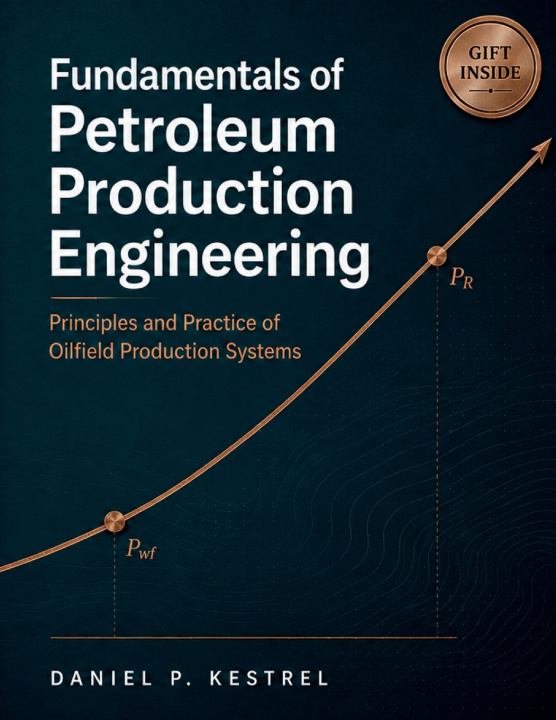
This book rebuilds the subject as what it actually is: one connected discipline, organised from the first page to the last around a single idea. A well is a chain of pressure-consuming components running from average reservoir pressure to the sales point, and no component can be understood, designed or optimised in isolation. Every equation states its units. Every derivation shows the step that matters. Every worked example carries units through every line of arithmetic, and every practice problem has a boxed answer to check against.
What this book helps you do
- Build inflow and outflow curves for a real well and locate the operating point where the two must meet
- Break a lumped total skin into its damage, perforation and partial-penetration parts, so the diagnosis points to a specific remedy
- Run a stepwise pressure traverse and size a rod pumping, gas lift or submersible installation from depth, rate, gas content, deviation and workover cost
- Read a dynamometer card and separate gas interference from fluid pound from a leaking valve, before the well is pulled
- Size separators for gas capacity and liquid retention, specify gravel and screen sizing, and manage scale, wax, asphaltene and hydrate risk
- Fit decline parameters defensibly, separate genuine decline from operational events, and estimate remaining reserves
- Test whether an acid job, a fracture treatment or a lift upgrade is worth its cost, using payout, discounted value and rate of return
Sixteen chapters cover fluid properties and phase behaviour, reservoir deliverability, well testing and pressure transient interpretation, multiphase flow and vertical lift performance, nodal analysis, completion and perforating design, chokes and flowlines, the three major artificial lift families, decline and reserves, surface facilities and metering, sand control and flow assurance, stimulation and workover evaluation, and field development economics. Reference material includes a symbols list, glossary, unit conversion tables and a correlation quick-reference.
Written for upper-level undergraduate petroleum and reservoir engineering students meeting production engineering as a dedicated subject for the first time, and for early-career engineers who need one systematically organised reference connecting classroom equations to field practice. Introductory reservoir engineering and fluid mechanics are assumed; this book builds on them rather than repeating them.
Open the first chapter and start seeing the well as one system instead of a stack of separate calculations.