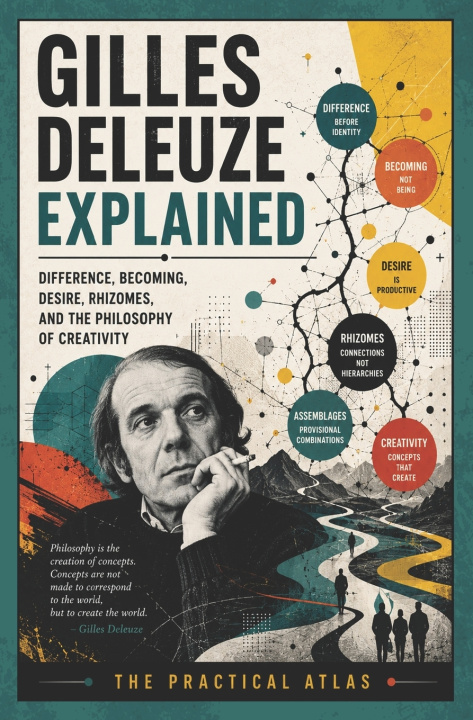
Gilles Deleuze Explained: Difference, Becoming, Desire, Rhizomes, and the Philosophy of Creativity introduces a philosopher often described as difficult by showing what his ideas actually do. Instead of treating Deleuze as a source of abstract jargon, this book explains the problems he was trying to solve: how to think about change without reducing it to fixed identities, how to understand desire as a force that produces social life, and how to describe a world made of shifting relations rather than isolated things. The result is a practical introduction for readers who want a serious account without specialist language.
The book begins with the intellectual background of Deleuze's work and the reasons he rejects stable essences and rigid categories. It then explains his central claim that difference comes before identity, along with his account of repetition as the creation of variation rather than the return of the same. From there, it develops his view of reality as multiplicity: a field of processes, intensities, and relations. The treatment of becoming makes these ideas concrete by showing how selves, institutions, and ways of life are continually formed and re-formed rather than simply given once and for all.
Later sections turn to concepts that readers often encounter but rarely see explained clearly. Desire is presented as productive and world-shaping, not as mere lack. Assemblages show how bodies, habits, tools, laws, and institutions combine into provisional structures. The rhizome clarifies Deleuze's account of networks, decentralized organization, and unexpected connections. The book also examines his analysis of power, capitalism, and control, including the shift from visible discipline to more diffuse forms of modulation that shape behavior through systems, routines, and environments. These discussions connect Deleuze's philosophy to digital platforms, workplaces, social organization, and everyday patterns of attention and movement.
The closing chapters focus on creativity, art, and concept-making. They show why Deleuze matters not only to philosophy, but also to readers interested in culture, politics, and invention. His work offers tools for questioning inherited assumptions, tracing how forms of life are assembled, and thinking more clearly about novelty, transformation, and freedom. For newcomers, students, and general readers, this is a reliable guide to difference, becoming, multiplicity, desire, assemblages, rhizomes, and the creative power of thought.
FROM THE HALF HOUR HELP SERIES OF BOOKS
The Half Hour Help Series is a collection of concise, practical guides designed to teach the basics of a subject or provide quick solutions to everyday problems. Each book is crafted to be read in about 30-60 minutes, making it ideal for busy readers who want to learn something new or solve a specific issue without wading through lengthy manuals or complex jargon.
Whether you're looking to understand a new concept, develop a skill, or tackle a challenge, these guides break things down into simple, actionable steps.
Focused on clarity and efficiency, the Half Hour Help Series covers a wide range of topics-from personal development and productivity to science and technology, wellness, culture, and beyond.
Every title is built around the idea that a little help can go a long way, and with just half an hour, readers can gain valuable insights and confidence to move forward.
It's smart support when you need it, without the fluff.