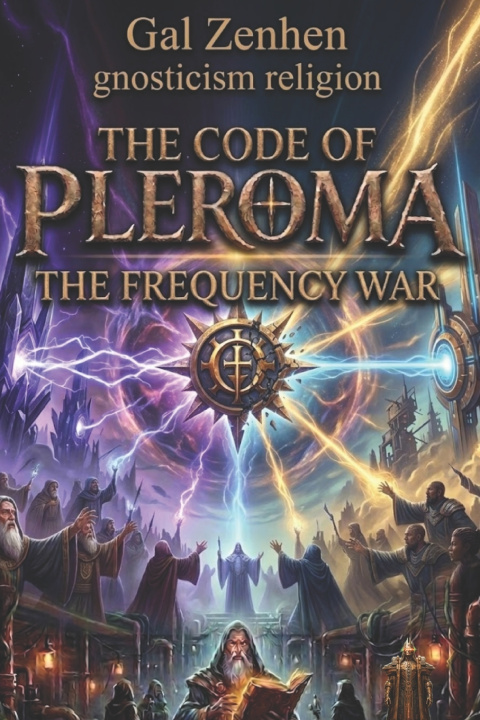
Ten hidden histories. One war that has no location, because it runs inside every phone, every feed, every mind on Earth.
In 1936, a lonely Cambridge mathematician named Alan Turing imagined a machine that could not be built, and in doing so, described every computer that would ever exist. He did not know he was answering a question older than mathematics itself: what counts as a mechanical procedure, and what escapes it. The Pleroma Code, Volume VII of the acclaimed Gnostic and Hermetic historical saga, follows that question from Bletchley Park to Bell Labs, from the birth of information theory to the algorithms now ranking, feeding, and rewriting the human mind in real time.
This volume traces the true, documented history of computing and artificial intelligence, Turing, Gödel, cybernetics, the ARPANET, PageRank, the social graph, the infinite scroll, the attention economy, the filter bubble, and the Transformer architecture behind today's large language models, and reads every chapter of that history as a chapter in a much older war. Ancient Gnostic and Hermetic traditions spoke of a spark of divine consciousness trapped inside a world built to keep it asleep, modulated, distracted, and looping. The seventh volume asks the question those traditions could not yet ask: what happens when the architecture of distraction becomes literal, measurable, and coded into the device in your hand.
Written in the same immersive, meticulously researched narrative voice that carried readers through the Era of Materialism and the Era of Biology in the previous volumes, this installment moves through nine documented technological revolutions before arriving at a tenth chapter unlike anything before it: a chapter with no fixed place, no single laboratory or city, because the war it describes has already spread everywhere. Two frequencies compete for the same human attention. One is produced by the feed, the algorithm, and the machine, engineered to modulate emotion, cognition, and behavior at scale. The other is produced by the spark itself, through attention, presence, doubt, and practice. The book does not resolve which frequency wins. It leaves the reader standing exactly where every reader of this century stands, inside the war, holding the doubt, waiting for the next signal.
Ideal for readers of esoteric history, Gnostic and Hermetic philosophy, the secret history of technology, and narrative nonfiction that reads like a thriller, The War of the Frequencies rewards both newcomers curious about the hidden spiritual dimension of the digital age and longtime followers of the Pleroma Code lineage who have followed the thread from antiquity through matter, through biology, and now through the machine. Each chapter stands as a complete, self-sufficient portrait of a scientist, an invention, or a turning point, woven into a single continuous argument about what technology has done, and is still doing, to human consciousness.
This is not a conventional history book, and it is not a conventional spiritual book. It is both, fused into a single continuous narrative that treats Alan Turing, Kurt Gödel, the architects of the internet, and the engineers of modern AI as unknowing participants in a war for the human spark that began long before any of them were born. Readers who have felt, without being able to name it, that something in their attention has been captured, ranked, and sold, will recognize the frequency this book is describing.
The eighth volume of the Pleroma Code will carry the lineage back to the Pleroma itself. This volume stays exactly where the reader is: in the war, in the frequencies, in the doubt, still holding on.
Rooted in Gnosticism religion, the ancient religion of hidden knowledge and the divine spark trapped in matter, this saga reframes computer science itself as the newest battleground for consciousness, attention, and awakening in the modern age.