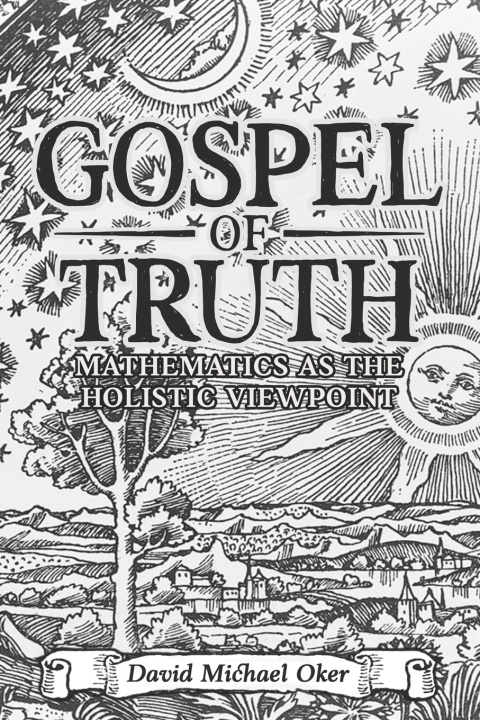
Gospel of Truth: Mathematics as the Holistic Viewpoint presents a history and philosophy of human knowledge, tracing thought from prehistoric survival and early symbolism to modern mathematics and science. David Michael Oker argues that mathematics is not merely a specialized subject or collection of formulas. It is humanity's most general, holistic method of understanding structure, relationships, transformation, and truth.
The book asks how knowledge arose and how human beings moved beyond the limited viewpoint of their immediate surroundings. Drawing on archaeology, anthropology, mathematics, mythology, philosophy, astronomy, and religious texts, Oker follows this journey through cave art, tally marks, early architecture, Göbekli Tepe, agriculture, Mesopotamian tokens, writing, Egyptian and Babylonian calculation, and Greek geometry. The architectural arch becomes a symbol of mathematical intelligence: separate parts create a coherent structure through their relationships.
Central to the book is the claim that abstraction made human language, number, and science possible. Early people recognized common patterns among different objects and events, turning concrete experiences into general concepts. Oker relates this process to Jacob Bronowski's philosophy of knowledge and Suzanne K. Langer's analysis of symbolic logic. Mathematics and poetry both employ analogy, he argues, but mathematics tests and transforms analogous structures logically, while mythology combines and personifies them through narrative.
The historical account follows the changing relationship among magic, mythology, religion, mathematics, and political power. It examines ancient Egyptian and Near Eastern gods, Greek myths, sacrificial kingship, Hebrew scripture, Greek rationalism, and Christianity. The author argues that myths represent early attempts to organize nature and society, but mathematical science gradually replaced supernatural explanations with demonstrable relationships. Greek mathematics marks a decisive intellectual renaissance, while the later loss of classical learning contributes to what the book describes as the Dark Ages.
A provocative part of the work reinterprets biblical and Christian traditions. Oker contends that Hebrew monotheism absorbed and renamed older deities, that Christian narratives reworked themes from solar mythology and Greek literature, and that James the Just provides the historical foundation behind the figure of Jesus Christ. He contrasts religious claims of "spiritual truth" with scientific and mathematical truth, which must remain open to questioning, analysis, and proof.
The narrative continues through the Renaissance and Scientific Revolution, showing how recovered Greek knowledge, global exploration, improved symbolism, and thinkers such as Copernicus, Kepler, Galileo, Descartes, and Newton transformed humanity's understanding of Earth and the universe. Zero, negative and complex numbers, algebraic notation, and higher number systems illustrate the larger thesis: knowledge advances by overcoming inherited assumptions, discovering hidden relationships, and incorporating older ideas into more general structures.
The appendices extend the argument into scientific humanism, logical critiques of concepts of God, parallels between Christian and Greek literature, religion as ideological control, Assyrian substitute kings, and algebraic symbolism. Together, these discussions defend a human-centered worldview grounded in reason, intellectual freedom, and scientific progress.
Written for open-minded readers interested in the origins of ideas, Gospel of Truth crosses the boundaries between mathematics, history, archaeology, mythology, religion, and philosophy. Its guiding question is not simply what humanity knows, but how human beings learned to know-and why mathematics offers the broadest viewpoint from which the development of knowledge can be understood.