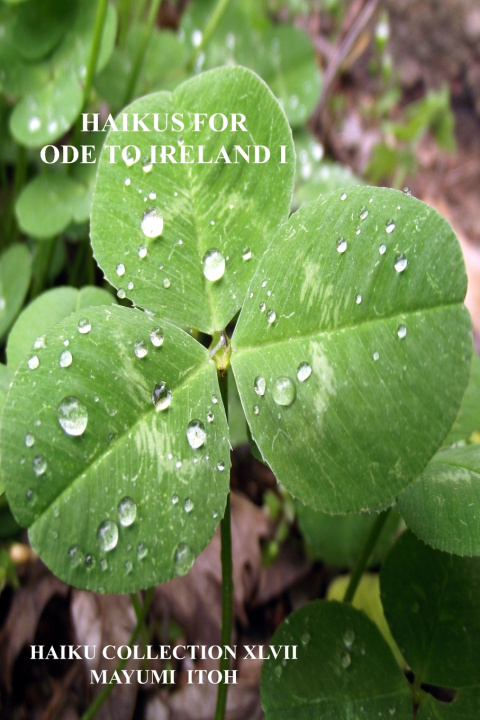
This is the forty-seventh bilingual haiku collection originally written by this author and introduces haikus featuring Irish culture, history, and literature, with parallel haikus about Japanese counterparts where applicable.
In November 2024, I had the privilege of attending a lecture and poetry recitation by Professor Paul Muldoon at Princeton University. At the beginning of the lecture, he stated that there was a commonality between the Irish and the Japanese, as in haiku. This was a new notion to me, and I was inspired by this revelation and my search for such commonality began. This took me on a journey to the history and culture of Ireland, as well as its landscapes, fauna and flora, and people.
The commonality between the Irish and Japanese cultures can be traced back to their ancient belief systems. Both subscribed to polytheism and both adopted foreign religions. Their indigenous beliefs harmoniously coexisted with foreign religions without qualms. In Ireland, the indigenous Celtic religion worshiped the sun, as demonstrated by their ancient ritual sites such as at the Hill of Tara and at the Newgrange. Celtic mythology then absorbed Catholicism.
In Japan, the native Shintoism was characterized by nature worship (a belief that gods exist in all things, such as mountains, rocks, trees, and water) and by a mythology with a plethora of gods and goddesses that matches Greek mythology. Despite the existence of this indigenous religion, Japanese emperors accepted and propagated Buddhism that was brought by ancient Chinese monks. To this day, the Japanese worship in both religions without making rigorous distinctions between them.
In addition, both Irish and Japanese mythologies believe in supernatural beings, such as fairies and ghosts. The commonality is pronounced on the eve of the Gaelic festival, Samhain, to celebrate the end of summer and the beginning of winter on November 1, and in the Japanese Bon ritual in mid-August. In the former, the Celtic people believed that the border between this world and the other world vanished on eve of Samhain and ancestors' souls and spirits became visible, and they go back and forth between the living world and the other world (this is said to be the origin of Halloween).
Similarly in Japan, during the Bon week, the souls of the ancestors are believed to descend on this world.
Further, a commonality can be found in their folklores and literatures. In Irish folklore, little creatures like goblins and leprechauns are common features, while in Japanese folktales, ghost stories and tales of supernatural spirits remain popular to this day.
An Irish newspaper reporter-turned-writer Patrick Lafcadio Hearn (1850-1904) naturalized in Japan as Koizumi Yakumo and introduced Japanese ghost stories called kwaidan to the English-speaking world.
In turn, W. B. Yeats found the 'answer' in Noh plays to his new plays for the Abbey Theatre he created in 1904. Noh plays distinguish themselves by a profound aestheticism, mysticism and symbolism. The story involves a dweller of the other world, such as a demon or a ghost, who possesses a human being and has the latter tell its story.
These are some of the commonalities between the Irish and Japanese cultures and literatures this author has found. The search goes on.
This haiku collection explores the hearts of the Irish people against the backdrop of their history and culture and expresses them in a form of concise poetry with annotations. Specifically, this haiku anthology presents 83 original haikus with appropriate season words per the Japanese calendar.