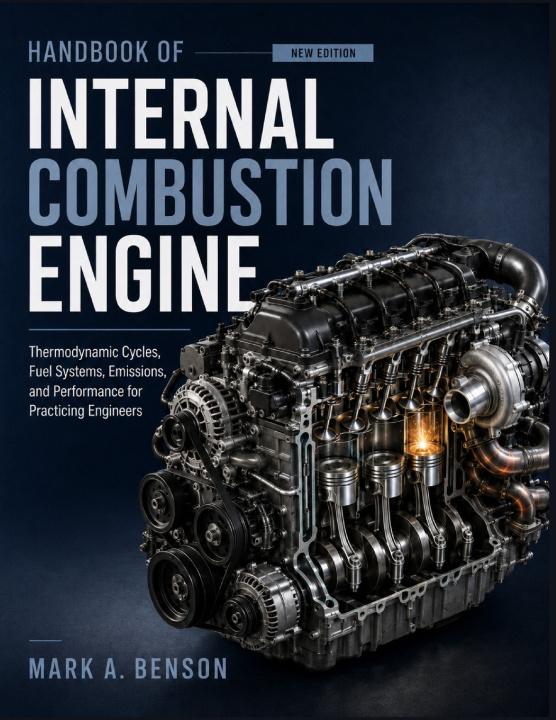
The internal combustion engine remains the dominant prime mover for road vehicles, off-highway machinery, and power generation worldwide, and it continues to evolve under pressure from tighter emission limits, higher efficiency targets, and new renewable fuels. Yet the engineer or student trying to master it is usually forced to choose between a purely theoretical thermodynamics text and a narrowly practical repair manual, with little that connects the two.
That gap creates real friction in practice. A calibration engineer who needs the heat-release equation behind a pressure trace may find it in one book and the knock-detection logic in another, with no shared notation between them. A student working through ideal-cycle efficiency has no direct route from that theory to the fuel-injection control strategy an engine control unit actually runs, or to the regulatory drive-cycle procedures a finished engine must pass. Without a single connected reference, engineers lose time reconciling inconsistent symbols and unit conventions, and students struggle to see how classroom thermodynamics becomes a working engine on a dynamometer.
This handbook addresses that gap directly. It is written as one continuous, cross-referenced work, in SI units throughout, that carries a reader from the fundamental thermodynamics of the engine cycle through combustion science, breathing and forced induction, heat transfer and friction, emissions after-treatment, embedded engine management, alternative fuels, hybrid integration, and finally the test-cell and calibration methods used to validate a real engine.
What You Will Gain:
- Follow a single notation and set of cross-references from first-law thermodynamics through to the equations used inside an engine control unit.
- Work through fully solved examples in every chapter, then check understanding with boxed-answer practice problems.
- Study the ideal Otto, Diesel, Dual, Atkinson, and Miller cycles alongside the more realistic fuel-air cycle, and see where real engines deviate from ideal predictions.
- Understand how spark-ignition and compression-ignition combustion develop inside the cylinder, including knock, ignition delay, and homogeneous charge compression ignition.
- Apply recognized correlations for heat transfer, friction, and forced-induction matching to design and calibration problems.
- Connect emissions-formation chemistry to after-treatment hardware and to the control strategy an engine management system uses to hold compliance.
What This Handbook Covers:
Coverage spans thermodynamic foundations and ideal-cycle analysis; combustion thermochemistry; spark-ignition and compression-ignition combustion; combustion diagnostics; in-cylinder flow; heat transfer; friction; turbocharging and supercharging; emissions after-treatment; engine management; alternative fuels; hybrid-electric integration; and engine testing and calibration.
Who This Handbook Is For:
This handbook is written for practicing mechanical, automotive, and powertrain engineers who need one connected reference; for calibration, test, and combustion-diagnostics engineers who need equations ready for direct use; and for advanced engineering students working through the equivalent of a rigorous one-year course in engine science.
Begin building a clearer, connected understanding of the internal combustion engine. Add this handbook to your reference library and start working through the theory, worked examples, and practical methods that carry an engine from first principles to the test cell.