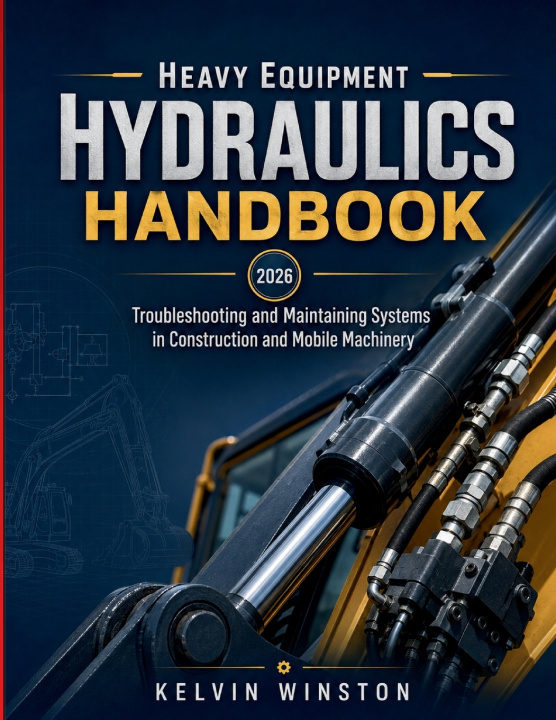
An excavator that swings slow only under combined load. A loader that lifts weakly after a repair that had nothing to do with hydraulics. A blade that feels strong at the start of a stroke and weak halfway through. None of these are mysteries once you can trace the energy path from engine to load.
Most hydraulics references teach components in isolation, without building the system-level diagnostic reasoning a technician needs when a real machine is complaining about something that could be hydraulic, mechanical, or both.
This handbook builds a complete, repeatable diagnostic method from first principles: the energy path from engine to load, core physical quantities, and every major component group, circuit architecture, and troubleshooting procedure used on real construction and mobile machinery.
What This Book Covers
- Trace the complete energy path from engine to load and separate hydraulic complaints from mechanical ones.
- Work safely with stored energy, high-pressure fluid injection hazards, and safe service procedures.
- Apply fluid power principles and hydraulic calculations to real machine problems.
- Select and maintain hydraulic fluids, contamination control, and filtration to protect a whole system.
- Understand pumps, motors, cylinders, and directional, pressure, and flow control valves as one connected circuit.
- Manage accumulators, reservoirs, coolers, hoses, fittings, seals, and manifolds.
- Read hydraulic schematics and trace circuits across open-center, closed-center, load-sensing, and flow-sharing systems.
- Diagnose hydrostatic drives, steering, braking, fan circuits, pilot controls, and electrohydraulic systems.
- Use hydraulic testing instruments and a systematic, root-cause troubleshooting method instead of parts-swapping.
- Plan preventive maintenance, flushing, commissioning, and overhaul across a machine's working life.
Key topics: hydraulic systems; fluid power principles; hydraulic pumps and motors; cylinders and actuators; directional and pressure control valves; hydraulic schematics; load-sensing and flow-sharing circuits; hydrostatic drives; electrohydraulics; hydraulic troubleshooting and diagnostics; preventive maintenance
Who this book is for: Heavy equipment technicians, mobile hydraulics mechanics, fleet maintenance staff, and engineering students who need to diagnose and maintain hydraulic systems on construction and mobile machinery - not just recognize component names but trace a real complaint to its actual cause.
Get your copy and start diagnosing hydraulic problems by tracing the energy path, not guessing at parts.