What happens when the company you acquire is bigger, stronger, or more established than your own?
Most M&A frameworks assume that the buyer has the financial strength, management depth, and organizational authority to absorb the target. But what happens when a smaller company acquires a business with greater scale, stronger customer relationships, deeper capabilities, or a more powerful market position?
In that situation, closing the deal is only the beginning.
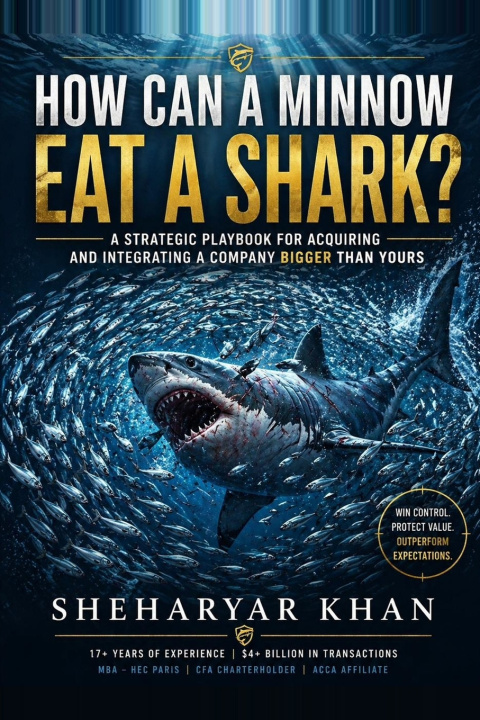
How Can a Minnow Eat a Shark? is a practical playbook for acquiring and integrating a company bigger than yours. It addresses the risks that arise when a smaller acquirer must finance, govern, protect, and ultimately create value from a business that may be capable of overwhelming its new owner.
The book introduces a complete ownership sequence built around three questions:
Should the Minnow hunt the Shark?
Determine whether acquisition is necessary, identify the strategic advantage ownership must secure, and test whether the valuation remains supportable under the pressures of asymmetric ownership.
What will survive the change of control?
Test whether revenue, contracts, suppliers, talent, operations, liquidity, authority, culture, and market identity can continue under a smaller new owner.
How can control be converted into value?
Use transaction agreements to contain risk, establish control through Survive, build a sustainable ownership model through Normalize, and create incremental free cash flow through Thrive.
Inside the book, readers will learn how to:
- Identify the Capability, Geography, or Contractual Leverage that must justify the acquisition
- Apply the Extended Worst Case to test whether the buyer can carry the downside
- Classify revenue as Transferable, Fragile, or Cannot Be Carried
- Determine whether margins and liquidity will remain sustainable after ownership changes
- Design governance, integration, culture, and identity around the realities of the acquired business
- Convert diligence findings into transaction protections and executable post-closing actions
- Sequence synergies without destabilizing the platform the acquisition was intended to secure
- Measure the final outcome through incremental free cash flow rather than headline synergy claims
The framework is supported by lessons from major asymmetric acquisitions, including Lenovo and IBM's PC division, Tata Motors and Jaguar Land Rover, Tata Steel and Corus, America West and US Airways, and AOL and Time Warner.
Written for founders, CEOs, corporate development professionals, investors, board members, advisers, and integration leaders, this book provides an operating framework for transactions where ownership is harder than the deal itself.
Because in asymmetric M&A, success is not determined by the deal you close.
It is determined by the ownership you can sustain.