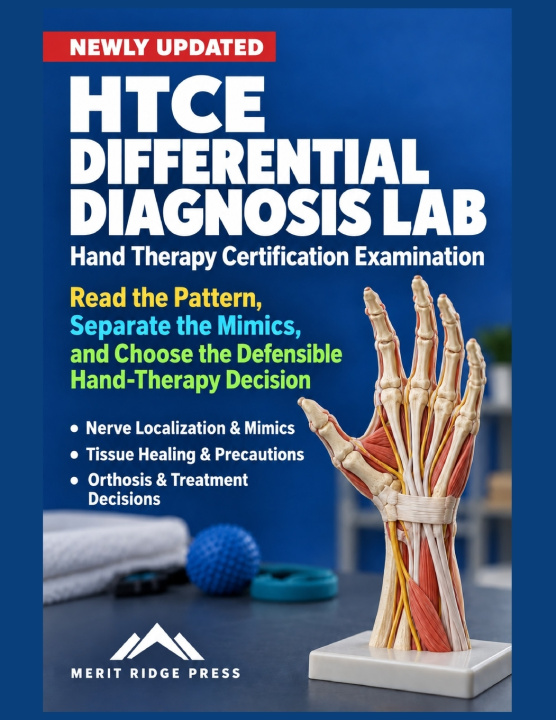
Two plausible answers. One decisive finding.
A sensory complaint points toward one explanation, but the motor pattern suggests another. A postoperative finding can change meaning with the healing stage. Active and passive motion can tell different stories. HTCE Differential Diagnosis Lab puts these close comparisons at the center of preparation for the Hand Therapy Certification Examination.
Read the pattern before naming the condition
Start with distribution, mechanism, timing, motion, and function. The book's Pattern → Discriminator → Decision method helps you identify the finding that separates the strongest alternatives, then check the conclusion against anatomy, tissue status, precautions, and the task being asked. Practice choosing from the whole case, with a specific reason for rejecting the closest alternative.
Connect assessment to the next decision
The same clinical facts can support different tasks. One question asks for localization; another asks which assessment belongs next, what limits progression, or when referral takes priority. Review peripheral nerve patterns, tendon and joint distinctions, wrist findings, tissue healing, orthoses, edema, wound care, and upper-extremity function within assessment, prognosis, intervention, and basic-science study.
Work through five 100-question tests
Five practice tests provide 500 main-test questions. The sequence moves through foundational differentiation, examination and workup, application to the plan of care, exceptions and boundaries, and integrated clinical cases. Complete each test before consulting its key. Checkpoints after Questions 25, 50, and 75 support pacing while keeping answers and teaching outside the test session.
Use explanations to examine the choice
Each practice test is followed by an answer key and teaching rationales. Review the explanation, pitfall, exam look-out, and rule to retain. Ask what made the keyed answer fit and why a tempting alternative failed under the stated conditions. An uncertain correct answer deserves review too: familiarity with a diagnosis does not establish that you selected the right next action.
Turn missed questions into a study route
Mastery dashboards and targeted retakes organize the follow-up work. Group errors by the distinction involved: localization, assessment selection, timing, interpretation, protection, or sequencing. Return to the related teaching before attempting the retake. Use performance to choose your next review topic and check whether you can apply the principle when the question's demand changes.
Keep final review specific
Chapter 8 consolidates the book's high-frequency clinical distinctions. Use nerve-localization comparisons, tendon patterns, healing constraints, orthosis decisions, assessment tools, visual maps, reference tables, clinical command cards, and a glossary. Review expected postoperative findings alongside escalation cues, and separate glide, motion, and load when a progression question turns on tissue protection. Compare expected recovery with precautions and escalation cues, and check how that distinction changes the next assessment or progression choice in cases.
Prepare with a defensible clinical method
Written for occupational therapists, physical therapists, and hand-therapy clinicians preparing for the HTCE. Eight chapters connect framework, practice, explanation, and final review. This independent study resource is not affiliated with or endorsed by the Hand Therapy Certification Commission. Approach the next question with a defined pattern, a discriminating finding, and a decision you can explain.