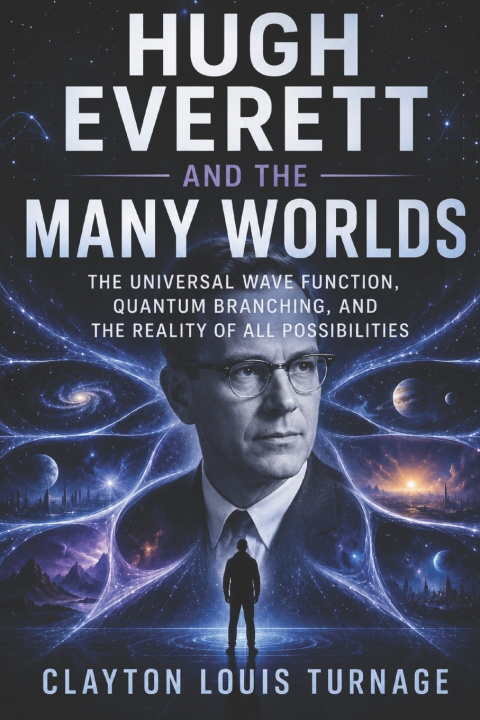
What if the universe never chooses?
For decades, quantum mechanics seemed to say that reality existed as a cloud of possibilities until measurement forced one outcome to become real. A particle could be here or there. An atom could decay or not decay. Schrodinger's cat could be alive or dead-until someone opened the box.
But Hugh Everett III asked a terrifyingly simple question:
What if the wave function never collapses?
In Hugh Everett and the Many Worlds, Clayton Louis Turnage explores one of the most radical ideas in the history of physics: the possibility that every quantum outcome remains real, branching into parallel histories within the universal wave function.
Everett did not add hidden variables. He did not place consciousness outside physics. He did not invent a mysterious collapse mechanism. Instead, he removed collapse entirely and asked what quantum mechanics says when applied to the entire universe-including observers, laboratories, memories, records, and worlds.
This book follows Everett's journey from the measurement problem to the relative-state formulation, from Schrodinger's cat to the universal wave function, from early neglect to the modern revival of Many-Worlds through decoherence, quantum cosmology, and quantum computing.
Inside, you will explore:
- The measurement problem and why collapse became so mysterious
- The universal wave function and the idea of quantum branching
- Schrodinger's cat without collapse
- The relationship between Everett, Einstein, Bohm, and Bell
- Why probability becomes strange if every outcome happens
- How decoherence helps explain why branches appear classical
- Why Many-Worlds remains one of the most controversial interpretations of quantum reality
Book 14 in The Foundations of Quantum Reality series, Hugh Everett and the Many Worlds is a gripping guide to the physicist who dared to ask whether reality is not one story, but a vast branching structure of all possible quantum outcomes.
If Bohm gave quantum theory hidden depth, Everett gave it branching vastness.
The universe may not collapse.
It may divide.
And the world you know may be only one branch of something far larger.