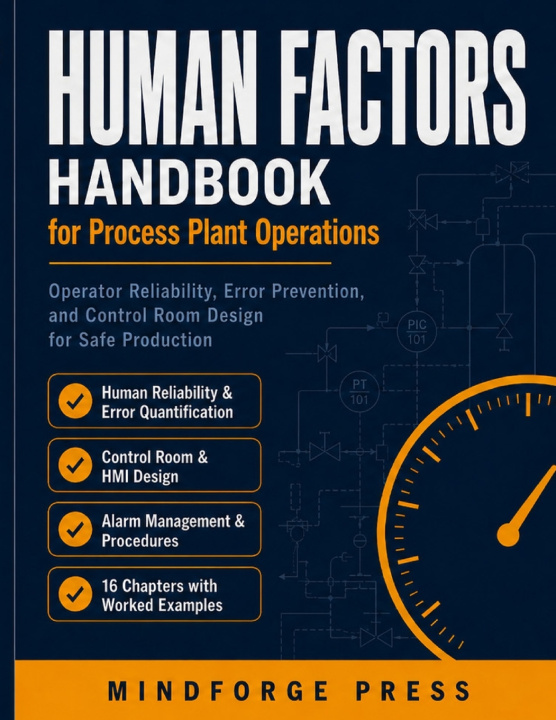
Ask ten engineers what caused an incident, and most will say "human error." In the industries where a mistake can cost lives, that answer is where the real work should begin - not where it ends.
When something goes wrong at a process facility, the reflex is to blame the person at the panel, retrain them, and add one more line to a procedure, while the conditions that made the error likely remain in place, waiting for the next capable operator. The same class of incident returns under a new name, because its true cause was never touched.
This handbook offers a better way to think about human performance, and a practical method to match. It treats human error as a symptom of how systems, jobs, and organizations are designed, and it equips you to find and remove the conditions that turn an ordinary slip into a catastrophe, so that safe, reliable operation becomes the outcome the design makes easy.
Inside, you will be able to:
- Understand why competent, well-trained people make predictable mistakes, and why "trying harder" is the wrong fix
- Analyze tasks and reason honestly about human reliability to find where error is most likely and most costly
- Evaluate and improve control rooms, interfaces, and alarm systems so the signals that matter are not lost in noise
- Write procedures people can follow under pressure, and judge where automation helps or quietly introduces new risks
- Manage workload, fatigue, and shift patterns as measurable contributors to performance
- Strengthen situation awareness, communication, and handover, and build the culture and competence that surface problems early
Key topics: operator cognition and its limits; error taxonomies and mechanisms; human reliability analysis; task analysis; control-room, workstation, and interface design; alarm management; procedures; automation and function allocation; workload, fatigue, and shift work; situation awareness and decision-making; communication, handover, and teamwork; safety culture; the integration of human factors into process-safety management; and competence, training, and learning from experience. Every chapter includes worked examples, practice problems, and answer keys.
Written for: Written for practicing engineers, operations and process-safety professionals, control-room and interface designers, plant and shift managers, and advanced students preparing to take responsibility for hazardous processes. It assumes familiarity with process operations but develops the human-factors science from first principles.
Open this handbook and begin developing the knowledge to design out error, support the people at the center of the plant, and operate extraordinary hazards safely.