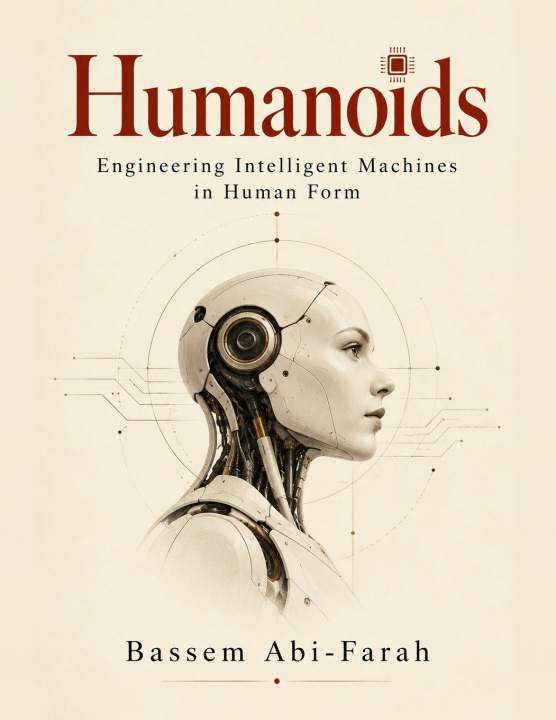
HUMANOIDS
Engineering Intelligent Machines in Human Form
What would it take to engineer an artificial human-one capable of moving, sensing, thinking, learning, communicating, and eventually matching or surpassing human capabilities?
HUMANOIDS explores one of the most ambitious engineering challenges of our time: transforming today's robots into intelligent artificial beings that reproduce not only the physical characteristics of humans, but also their cognitive, sensory, and selected biological functions.
Written by engineer, inventor, and technology architect Bassem Abi-Farah, this book goes beyond describing existing humanoid robots. It presents a comprehensive, systems-engineering blueprint for designing, integrating, and validating the technologies required to create increasingly capable artificial humans.
Across 49 chapters and nine parts, the book examines the fundamental engineering problems that must be solved to achieve this vision:
The Artificial Human Body: Engineering skeletons, artificial muscles, actuators, tendons, dexterous hands, artificial skin, locomotion, balance, and energy-efficient movement.
Human Senses: Reproducing vision, hearing, touch, smell, taste, proprioception, and multisensory perception.
The Artificial Brain: Developing cognitive architectures incorporating reasoning, planning, persistent memory, world models, creativity, autonomous learning, and self-assessment.
Complete Humanoid Autonomy: Integrating intelligence, perception, physical control, and safety to enable increasingly independent operation in complex environments.
Human-Like Communication and Behavior: Engineering natural speech, emotional expression, personality, identity, and social interaction.
Bionics and Biological Integration: Exploring artificial organs, replacement body parts, bidirectional brain-computer interfaces, and the long-term possibilities of biological-artificial integration and human augmentation.
Engineering the Complete Humanoid: Bringing these technologies together through system architecture, digital twins, simulation, verification, and physical implementation strategies.
At the center of the book is Humanoid-1, an integrated reference architecture that translates engineering principles into a practical development program. Readers explore simulation and implementation using Python, MuJoCo, and open-source technologies, with advanced NVIDIA Isaac, Omniverse, GR00T, and Nemotron development pathways. A zero-additional-cost simulation baseline is designed for compatible existing Apple Silicon hardware.
The book also examines the economics, legal considerations, ethics, safety, and societal implications of a future in which intelligent humanoids work alongside people.
The ultimate objective is more ambitious than building robots that resemble humans. It is to establish an engineering pathway toward artificial beings capable of reproducing, integrating, and potentially extending human functions.
Combining robotics, artificial intelligence, biomechanics, neuroscience, telecommunications, and systems engineering, HUMANOIDS is intended for engineers, researchers, AI developers, robotics professionals, students, and technology innovators seeking to understand and contribute to the next generation of embodied intelligence.
From robotics to humanoids. From humanoids to artificial humans. From artificial humans toward capabilities beyond biological limitations.
HUMANOIDS is a blueprint for engineering that future.