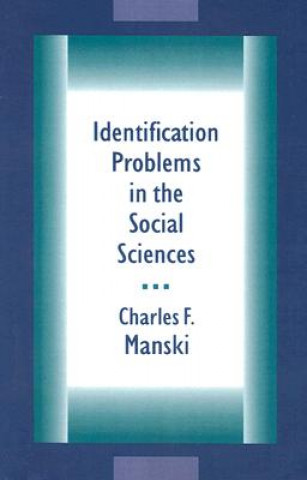
Könyv Identification Problems in the Social Sciences Charles F. Manski

Identification Problems in the Social Sciences

Nyelv: Angol
Kötés: Puha kötésű
Elérhetőség: Beszállítói készleten
Küldés 9-15 napon belül
17 236 Ft
This text provides a language and a set of tools for finding bounds on the predictions that social a...

Információk a könyvről

Nyelv
Angol
Kötés
Könyv - Puha kötésű
Kiadva
2019
oldal
194
EAN
9780674442849
ISBN
0674442849
Enbook ID
04636122
Súly
292
Méretek
143 x 222 x 12

Teljes leírás

This text provides a language and a set of tools for finding bounds on the predictions that social and behavioural scientists can logically make from non-experimental and experimental data. Economist Charles Manski draws on examples from criminology, demography, epidemiology, social psychology and sociology as well as economics to illustrate this language and to demonstrate the broad usefulness of the tools. There are many traditional ways to present identification problems in econometrics, sociology and psychometrics. Some of these are primarily statistical in nature, using concepts such as flat likelihood functions and non-distinct parameter estimates. Manski's strategy is to divorce identification from purely statistical concepts and to present the logic of identification analysis in ways that are accessible to a wide audience in the social and behavioural sciences. In each case problems are motivated by real examples with real policy importance, the mathematics is kept to a minimum, and the deductions on identifiability are derived providing fresh insights. Manski begins with the conceptual problem of extrapolating predictions from one population to some new population or to the future. He then analyzes the fundamental selection problem that arises whenever a scientist tries to predict the effects of treatments on outcomes. He specifies assumptions and develops his non-parametric methods of bounding predictions. Manski shows how these tools should be used to investigate common problems such as predicting the effect of family structure on children's outcomes and the effect of policing on crime rates. Successive chapters deal with topics such as the use of experiments to evaluate social programmes, the use of case-control sampling by epidemiologists studying the association of risk factors and disease and the use of intentions data by demographers seeking to predict future fertility. The book closes by examining two central identification problems in the analysis of social interactions: the classical simultaneity problem of econometrics and the reflection problem faced in analyses of neighbourhood and contextual effects.

Érdekelheti

Hearing Gesture

Susan Goldin-Meadow
10 712 Ft

Cotting School

David Manzo
7 459 Ft

Porn Is Not Sex Ed!

Jessica Melendez
5 993 Ft

Tale of Two Oceans

E. I. (Ezekiel I. ) Barra
7 104 Ft
9 718 Ft

Patty Berg

Kevin Kenny
16 907 Ft
9 902 Ft
14 239 Ft
17 749 Ft
6 847 Ft

Female Labor Supply

James P. Smith
56 868 Ft

Emerson as Poet

Hyatt Howe Waggoner
12 242 Ft

Alan Moorehead

Tom Pocock
9 943 Ft

Novel Living

Lisa Occhipinti
6 821 Ft

Azok a vásárlók, akik ezt a könyvet megvásárolták, a következőket is megvásárolták