Infectious diseases can turn one clinical decision into a maze of questions.
Which infection is most likely? Which tests should you order? Should treatment begin now? Which antimicrobial makes sense-and when should you narrow or stop it?
The problem isn't that you haven't learned enough medicine.
Infectious diseases are often taught as thousands of organisms, drugs, resistance patterns, and guidelines. But in practice, you need something simpler: a clear way to decide what matters next.
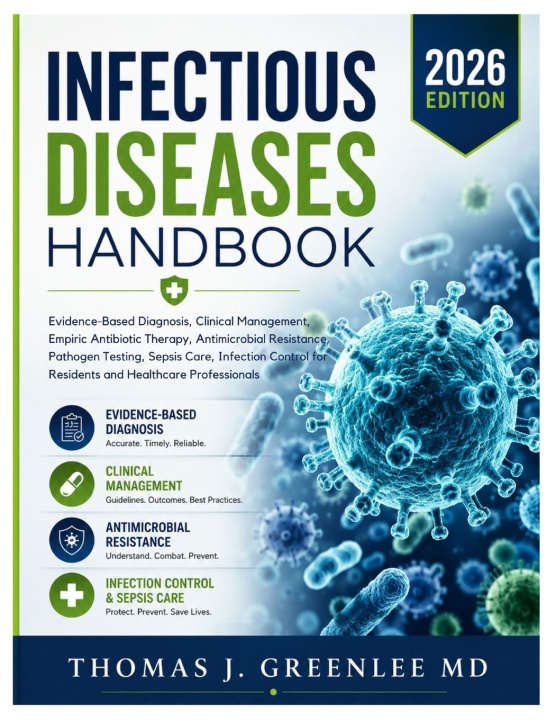
Infectious Diseases Handbook 2026 turns complex information into practical, step-by-step clinical reasoning you can use when facing real patient problems.
Instead of drowning you in jargon, it helps you move logically from:
Presentation → likely source → diagnostic testing → probable pathogens → empiric treatment → results → targeted therapy → reassessment.
No complicated explanations.
No endless facts without clinical context.
No wondering where to start.
Inside, You'll Learn How To:• Approach fever and sepsis systematically and recognize when immediate treatment matters.
• Choose the right diagnostic tests and specimens for respiratory, urinary, CNS, gastrointestinal, bloodstream, skin, bone, joint, and other infections.
• Think through empiric antimicrobial therapy using infection site, likely pathogens, severity, patient factors, and resistance risk.
• Interpret cultures and susceptibility results and understand when treatment should be narrowed, changed, or reassessed.
• Recognize major resistance patterns, including MRSA, VRE, ESBL, AmpC, CRE, and multidrug-resistant organisms.
• Work through bacterial, viral, fungal, mycobacterial, parasitic, zoonotic, and travel-associated infections with a clearer clinical approach.
• Manage higher-risk patients, including those with HIV, neutropenia, transplantation, pregnancy, older age, immunosuppression, or critical illness.
• Recognize when antimicrobials aren't enough and source control, drainage, device removal, imaging, or surgical evaluation may be needed.
• Apply prevention and stewardship principles through vaccination, isolation, exposure management, and responsible antimicrobial use.
The goal is simple:
From "I know the facts, but I'm not sure what to do next."
To "I can organize the problem and work through the next clinical decision logically."
Written in clear language with practical examples and step-by-step reasoning, Infectious Diseases Handbook 2026 is designed for medical students, residents, physicians, nurse practitioners, physician associates/assistants, pharmacists, nurses, and other healthcare professionals who want a practical clinical reference without unnecessary complexity.
Stop memorizing infectious diseases as disconnected facts. Start learning how to reason through them.
Get your copy of Infectious Diseases Handbook 2026 and build a clearer, more practical approach to infectious disease diagnosis and management.