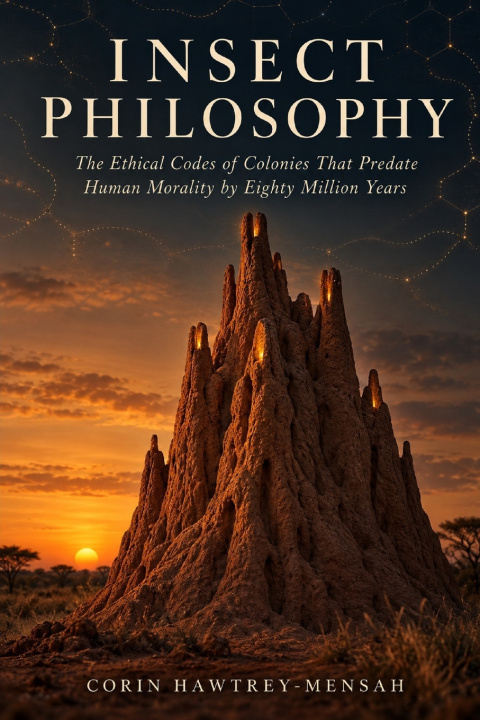
Eighty million years before the first human asked what it means to be good, a colony of insects had already answered.
Long before Aristotle, before Hammurabi's code, before the first campfire debate about right and wrong, termites were policing cheaters, honeybees were practicing collective justice, and ant colonies were making life-or-death decisions through a process more rigorous than most human parliaments. They did it all without a single conscious thought.
In Insect Philosophy, evolutionary biologist Corin Hawtrey-Mensah takes you deep into the hidden societies living just outside your door, revealing a world where loyalty is enforced by chemistry, sacrifice is calculated by genes, and fairness emerges from nothing more than millions of years of blind trial and error. Drawing on decades of rigorous, peer-reviewed research, from Hamilton's revolutionary mathematics of self-sacrifice to Thomas Seeley's Nobel-adjacent discoveries about honeybee democracy, this book asks the question that has haunted moral philosophy for centuries: is right and wrong something we invented, or something we inherited?
You'll travel to a thirty-four-thousand-year-old termite mound that outlasted Rome, into the war zones of supercolonies spanning hundreds of miles, and inside the ruthless chemical espionage of parasitic queens who hijack entire civilizations without firing a single shot. Along the way, you'll discover just how much of your own sense of loyalty, tribe, and justice may be running on the same ancient software.
This is not a book that flatters human exceptionalism. It's a book that complicates it, and in doing so, makes the case for something more interesting: that the conscious, reasoned choice to be good, however fragile, however young, however uniquely ours, might be the only thing in the natural world actually worth calling a virtue.
Rigorously researched, vividly written, and impossible to put down, Insect Philosophy will change the way you look at the ground beneath your feet, and at yourself.