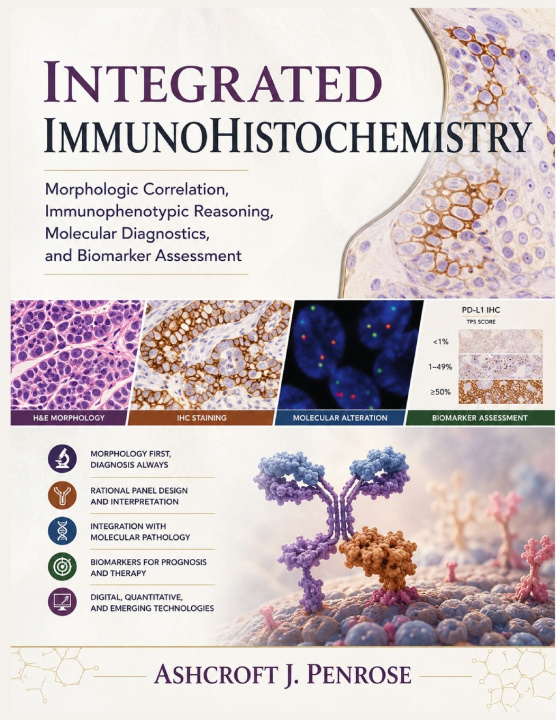
Integrated Immunohistochemistry provides an advanced framework for understanding and applying immunohistochemical methods in contemporary diagnostic pathology. Rather than presenting immunohistochemistry as a collection of antibody lists, this book examines how immunophenotypic evidence is generated, evaluated, and integrated with tissue morphology, clinical information, and complementary laboratory investigations.
The book explores the scientific principles underlying antigen detection, antibody specificity, tissue preparation, antigen retrieval, detection systems, staining controls, assay validation, and technical quality assurance. Particular emphasis is placed on recognizing meaningful staining patterns, distinguishing biologic expression from technical artifact, and understanding the limitations that influence interpretation.A central focus is the use of immunohistochemistry as a morphology-driven diagnostic tool. Readers are guided through rational immunopanel construction, sequential testing strategies, lineage assignment, interpretation of poorly differentiated neoplasms, evaluation of metastatic tumors, and resolution of challenging differential diagnoses. The approach emphasizes why a particular marker is selected, what competing diagnoses it helps distinguish, and how combinations of results can provide stronger diagnostic evidence than isolated stains.
The text also examines immunohistochemistry across surgical pathology and hematopathology, including epithelial, hematolymphoid, melanocytic, mesenchymal, vascular, myogenic, neural, neuroendocrine, and organ-specific neoplasms. Special attention is given to situations in which immunophenotypic findings must be reconciled with morphology and clinical or radiologic information.Beyond conventional diagnostic applications, the book addresses the expanding role of immunohistochemistry in molecular and precision pathology. Molecular surrogate markers, DNA-repair proteins, therapeutic biomarkers, predictive assays, quantitative assessment, digital image analysis, multiplex immunohistochemistry, and spatial protein profiling are considered within the context of established clinical practice versus emerging applications.
Throughout, the emphasis remains on diagnostic reasoning rather than memorization. Readers are encouraged to approach every stain as an evidence-generating test whose significance depends on morphology, cellular localization, staining distribution, controls, assay performance, and the specific clinical question being addressed.Designed for pathologists, pathology residents and fellows, laboratory scientists, oncologists, and advanced medical trainees, this volume serves as both a practical diagnostic reference and an academic foundation for understanding how immunohistochemistry contributes to modern integrated pathology.