Understanding photonics is one thing. Designing a photonic integrated circuit that can actually be manufactured, packaged, and tested is another.
Does understanding waveguides and optical components translate into confidence designing complete PIC architectures?
Are simulation results leaving unanswered questions about fabrication tolerances, packaging losses, and actual device performance?
Does navigating PDKs, Python workflows, layout verification, and foundry requirements feel unnecessarily complicated?
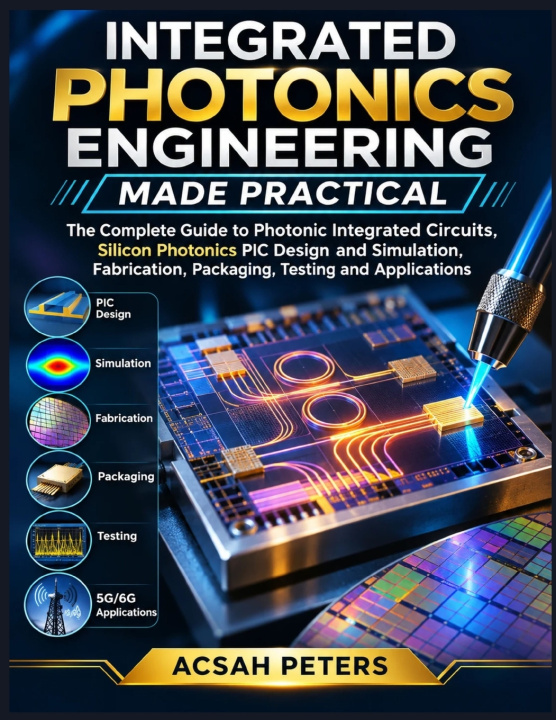
Integrated Photonics Engineering Made Practical addresses these challenges through a structured engineering approach connecting physical principles with practical implementation. It combines optical fundamentals, worked calculations, computational modeling, design automation, manufacturing considerations, and measurement validation in one progressive technical reference.
Inside this Guide you will Discover
- Master Integrated Photonics Fundamentals.
- Understand Optical Waveguides and Guided Modes.
- Compare Silicon, SiN, and InP Platforms.
- Design Passive Photonic Components.
- Understand Lasers, Modulators, and Detectors.
- Apply FDTD and Eigenmode Simulation.
- Use Python for Photonic Engineering.
- Perform Photonic Circuit Modeling.
- Navigate PDKs and Component Libraries.
- Automate PIC Layout Generation.
- Apply Design Rule Checking (DRC).
- Prepare Foundry-Ready Designs and Tape-Outs.
- Understand Optical Packaging and Fiber Coupling.
- Perform Testing, Characterization, and Optimization.
- Explore Optical Interconnects, AI Infrastructure, and Emerging Photonic Technologies.
Whether readers are concerned about expensive proprietary software, overly theoretical explanations, or insufficient manufacturing guidance, this book emphasizes transferable engineering principles, accessible computational workflows, practical examples, and realistic design constraints. It establishes an intermediate-level foundation without assuming access to a particular commercial simulation suite or advanced photonics laboratory. The focus is understanding why engineering decisions matter, not simply following instructions.
If you want to understand the complete PIC development process, from optical principles to fabrication and testing, add this essential engineering reference to your technical library.