An authentic document can still be used to support a misleading conclusion. A widely repeated report may trace back to one source. A polished AI-generated briefing can conceal serious gaps in the evidence.
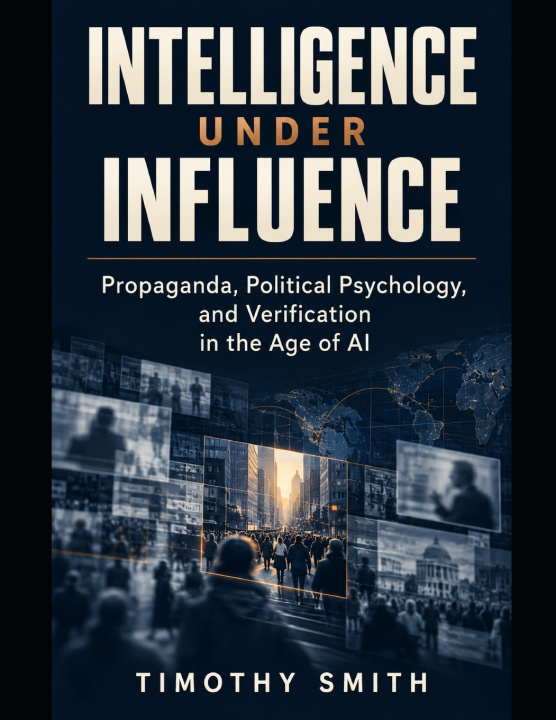
Intelligence Under Influence: Propaganda, Political Psychology, and Verification in the Age of AI is an advanced textbook on evaluating contested information and developing defensible judgments. Timothy Smith connects the psychology of belief and persuasion with the practical demands of source evaluation, corroboration, and analytical reporting.
Across 16 chapters, readers examine how identity, motivation, repetition, framing, and apparent consensus shape judgment. The book then applies verification methods to documents, statistics, briefings, and claims involving images, audio, and video.
Readers learn to:
Trace claims to their origins and distinguish independent corroboration from circular reporting.
Separate authenticity, factual accuracy, context, and evidence of intent.
Assess competing explanations for misleading information, including error, advocacy, satire, and deliberate deception.
Evaluate the strengths and limits of provenance records and AI detection tools.
Use AI in analytical work while checking sources, calculations, and generated claims.
Report supported, contradicted, and unresolved findings, explain confidence, and revise judgments as evidence changes.
Four original fictional case studies, including an integrated verification exercise, give readers opportunities to work through conflicting evidence and changing assessments. Charts, tables, 64 exercises with separate commentary, and six reusable assessment forms with completed examples support both study and practical application.
Written for intelligence and security practitioners, investigators, researchers, and advanced students, Intelligence Under Influence develops the habits needed to explain how a conclusion was reached, what supports it, and where its limits remain.