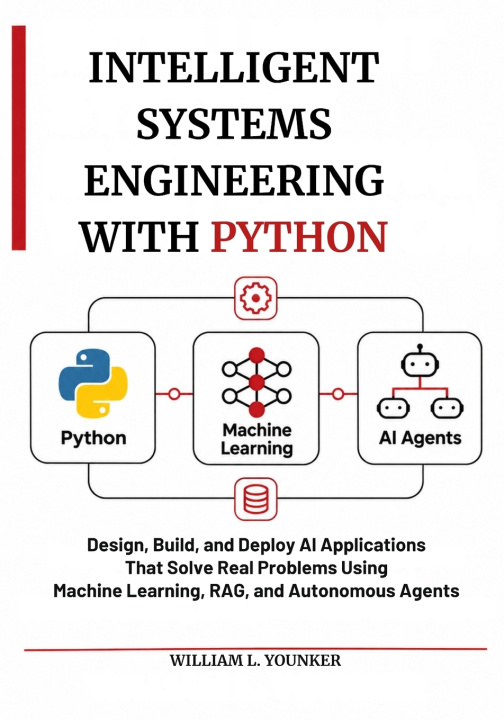
Intelligent Systems Engineering with Python: Design, Build, and Deploy AI Applications That Solve Real Problems Using Machine Learning, RAG, and Autonomous Agents
Problem
Stop building AI demos that work once. Start engineering intelligent Python applications that can handle real-world demands.
You know Python. You understand the potential of artificial intelligence. But how do you turn machine learning models, large language models, retrieval systems, and autonomous agents into complete applications that work together reliably?
Building an AI prototype is one thing. Designing a system that manages data, retrieves accurate information, executes authorized actions, handles failures, and operates in production is another.
For Python developers, software engineers, and aspiring AI engineers, the challenge isn't simply learning another framework. It's understanding how to connect intelligent components into secure, maintainable, and deployable software.
You need practical engineering skills, not another collection of disconnected AI examples.
Solution
Intelligent Systems Engineering with Python provides a structured, hands-on approach to designing, building, testing, and deploying intelligent applications using modern Python tools and AI technologies.
Through progressive projects and practical code examples, you'll move from foundational machine learning to retrieval-augmented generation (RAG), autonomous AI agents, multi-agent orchestration, and production deployment.
You'll learn how to:
Build practical AI applications: Develop predictive machine learning systems, integrate large language models, and expose intelligent capabilities through Python APIs.
Engineer reliable RAG systems: Implement document processing, embeddings, vector search, and evidence-grounded responses.
Create autonomous AI agents: Design goal-driven agents with tool execution, persistent memory, reusable skills, human approval, and recoverable workflows.
Connect intelligent systems: Use Model Context Protocol (MCP), Agent2Agent (A2A), and structured communication to integrate tools and coordinate multiple agents.
Prepare AI applications for production: Apply FastAPI, PostgreSQL, Docker, automated testing, evaluation, observability, security controls, and deployment practices.
The explanations focus on practical implementation and engineering decisions rather than unnecessary mathematical complexity.
Whether you're expanding your Python development skills, transitioning into AI engineering, or building intelligent software for professional projects, this book gives you a clear implementation path.
Proof
Five connected projects demonstrate how individual AI technologies become a complete intelligent application.
You'll build an Intelligent Fault Detection System, a Knowledge Retrieval Assistant, an Autonomous Service Operations Agent, and an Interoperable Multi-Agent Operations System.
These projects culminate in the Intelligent Operations Hub, an integrated Python application combining predictive analytics, document retrieval, agent coordination, persistent workflows, authorization, and operational services.
Throughout the book, you'll work with practical Python implementations, configuration examples, testing procedures, troubleshooting guidance, and production handoff checklists.
The emphasis is on measurable behavior, controlled execution, security, and maintainability-not simply generating impressive AI responses.
By applying these techniques, you can develop the confidence to design intelligent applications that move beyond experimentation toward dependable software systems.