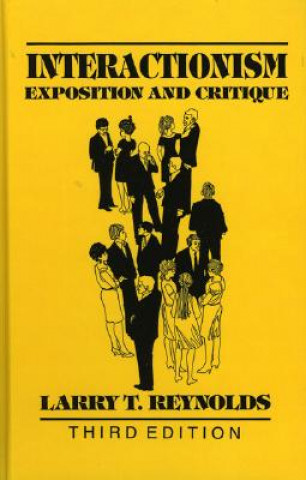
This book presents an overview of that theoretical framework known as symbolic interactionism. It details the major intellectual and philosophical antecedents of the interactionist perspective, i.e., evolutionism, Scottish moral philosophy, German idealism, pragmatism, and functional psychology. Under the heading evolutionism, the Darwinian notion of the mutually determinative relationship existing between environments and organisms is discussed, as are Henri Bergson's conceptions of the nature of radical, abrupt departures from earlier life forms and of the emergence of novel events. Scottish moral philosophers are dealt with in terms of their contribution to the conceptual inventory of symbolic interactionism. Of particular relevance here are concepts such as the impartial spectator 'sympathy', the 'I', the 'Me', 'role taking', 'generalized other', and 'looking-glass self.' Those German idealists exerting an impact on George Herbert Mead and symbolic interactionism, namely, Fichte, Von Schelling, Kant, and Hegel receive mention. American pragmatic philosophy is then summarized, and special attention is given to the writings of Charles S. Pierce, William James, and John Dewey.
The second chapter discusses the major early interactionists, i.e., Charles Horton Cooley, William Isaac Thomas, and George Herbert Mead. Part two discusses the principal varieties of contemporary symbolic interactionism. Major 'schools' receiving attention are the 'Chicago School', the 'Iowa School', the 'Dramaturgical Genre', and 'Ethnomethodology.' A unique feature of this section is that it ends with an attempt to provide a single sentence description of the symbolic interactionist viewpoint. Mead's writings are dealt with in terms of his utilization of such pivotal concepts as symbols, role taking, self, society, and mind. A listing of the primary characteristics of the early interactionism closes out this section of the book. The third section provides a representative set of criticisms of interactionism. They are provided by interactionists and also by those who favor other sociological orientations. Both early and contemporary interactionism come under fire, and the criticisms range from the mild to the sharp. The perspective stands accused, by friend and foe alike, of being quaint, ahistorical, noneconomic, imprecise, and apolitical.
It has also ignored the unconscious and emotive components in human behavior, and it manifests a rather strong astructural bias. Interactionists may now be in the process of correcting these defects.