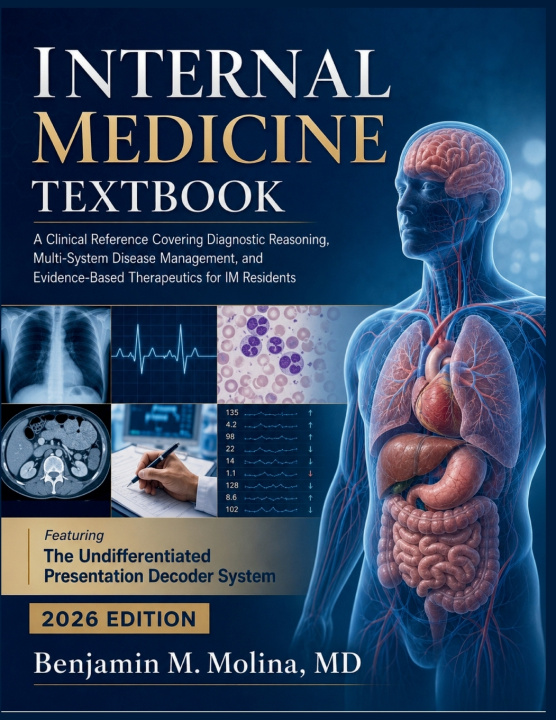
Internal medicine begins before a diagnosis exists - with a presentation, a time constraint, and a clinician who has to be right without yet having all the data. This reference is built around that exact moment. It moves from the mechanics of clinical reasoning - dual-process thinking, cognitive bias, Bayesian test interpretation - through every major organ system a general internist covers, from acute coronary syndromes and four-pillar heart failure therapy to cirrhotic decompensation, comorbidity-aware diabetes management, and the goals-of-care conversations that close a patient's course. Every chapter treats the organ system as a vehicle for the same underlying skill: turning a first impression into a defensible plan.
Embedded at every major decision point is The Undifferentiated Presentation Decoder System - a five-part callout that names the presenting pattern, its diagnostic signature, the single pivot finding, the look-alikes it must be distinguished from, and the anchor worth remembering under pressure. Every instance in the book is indexed at the back for bedside lookup.
What This Book Puts in Your Hands
• Catch the anchoring errors that cause real misses - cognitive-bias callouts built from the specific traps residents fall into on rounds and in clinic.
• Time reperfusion correctly - STEMI and NSTE-ACS strategy selection built around the realistic transfer and treatment window, not a default protocol.
• Run the four-pillar HFrEF regimen right - simultaneous initiation and uptitration logic, not the outdated sequential approach.
• Manage the decompensating cirrhotic - ascites, spontaneous bacterial peritonitis, hepatic encephalopathy, and hepatorenal syndrome as one connected reasoning chain.
• Select diabetes therapy by comorbidity, not glucose alone - SGLT2 and GLP-1 positioning, plus euglycemic DKA recognition.
• Move a stroke patient through the CT-decision branch point without losing the minutes that cost brain tissue.
• Scan all forty-eight Decoder patterns in one master index, cross-referenced by organ system, for a five-minute refresh before rounds.
Put the reasoning behind every organ system in one reference - before your next undifferentiated patient walks in.