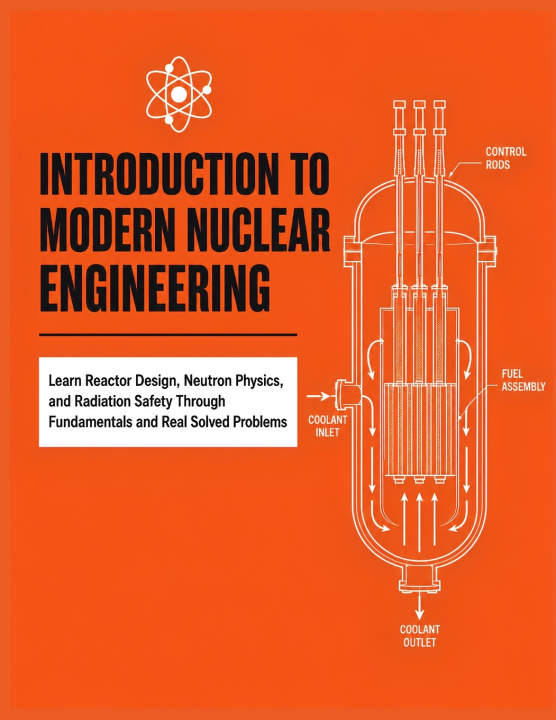
From a single neutron to a complete reactor system
Nuclear engineering can seem like a collection of unrelated specialties: particle interactions, reactor kinetics, heat removal, materials, radiation protection, control systems, and safety analysis. This textbook connects them into one engineering story, showing how microscopic events become measurable behavior and practical design decisions.
Introduction to Modern Nuclear Engineering develops the subject from first principles and reinforces each major idea with equations, worked calculations, labeled diagrams, and end-of-chapter practice. The progression begins with atomic structure, binding energy, radioactive decay, and radiation detection. It then builds through neutron cross sections, moderation, transport, diffusion, multiplication, criticality, point kinetics, delayed neutrons, feedback, and reactor control.
What you will learn
- Calculate decay, attenuation, reaction rates, neutron balance, multiplication, and reactivity.
- Apply transport and diffusion models to flux shapes, leakage, and critical dimensions.
- Connect power production to fuel temperature, coolant flow, heat transfer, and thermal limits.
- Compare pressurized-water, boiling-water, and advanced reactor systems using common engineering criteria.
- Evaluate shielding, dose, fuel-cycle choices, safeguards, accident sequences, reliability, and risk.
Every chapter includes a step-by-step derivation with variables and units defined in context. More than fifty worked examples demonstrate how to organize assumptions, select governing relations, carry units, and interpret the result. Thirty-six labeled technical figures make reactor geometry, neutron behavior, plant systems, protection barriers, and control logic easier to visualize. More than 140 review problems, paired with answer sections, support independent study and course assignments.
The final chapters integrate instrumentation, control, human factors, economics, waste management, probabilistic risk assessment, and preliminary reactor design. That broad view helps readers see why a locally reasonable choice can create consequences elsewhere in the plant.
Who this textbook is for
Use this book if you are an engineering student entering nuclear science, an early-career professional strengthening reactor fundamentals, an engineer moving from a neighboring discipline, or a technically prepared reader seeking a calculation-centered introduction. Familiarity with algebra, introductory calculus, and basic physics is helpful.
Work through the examples, test each model against its assumptions, and use the review problems to move from particle-scale physics to system-level judgment.