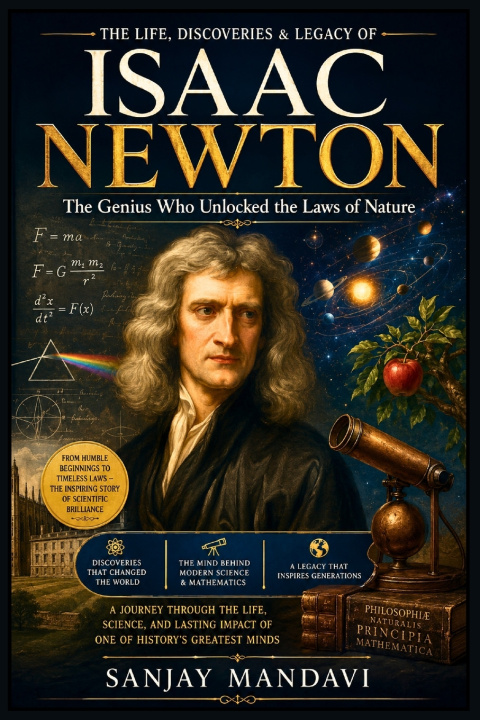
This book provides a detailed and engaging exploration of the life, discoveries, and lasting influence of Isaac Newton, one of the most influential scientists in history. Organized in a chronological and thematic format, it guides readers through the major events, achievements, and ideas that shaped both Newton's life and the development of modern science.
The journey begins with the historical setting of seventeenth-century England and Newton's early years, highlighting the experiences that nurtured his curiosity and passion for learning. It then follows his education at Trinity College, Cambridge, where his remarkable talent for mathematics and natural philosophy began to flourish.
Readers will explore Newton's revolutionary work during the Great Plague years, including the development of calculus, his pioneering research on light and optics, and the invention of the reflecting telescope. The book explains how these discoveries laid the foundation for many advances in science and technology.
A significant portion of the book is devoted to Newton's greatest achievements-the formulation of the three laws of motion and the theory of universal gravitation. It also examines the writing of Principia, one of the most important scientific works ever published, and discusses how Newton's methods transformed scientific thinking.
In addition to his scientific accomplishments, the book explores Newton's professional roles as a Member of Parliament, Master of the Royal Mint, and President of the Royal Society. It also discusses his scientific rivalries, including the famous calculus controversy, and offers insight into his personality, character, and enduring legacy.
Designed for students, educators, researchers, competitive exam aspirants, and curious readers, this book combines historical context with scientific explanation in a clear and accessible style. It serves as both an introduction to Isaac Newton's life and a valuable reference for understanding the foundations of classical science.