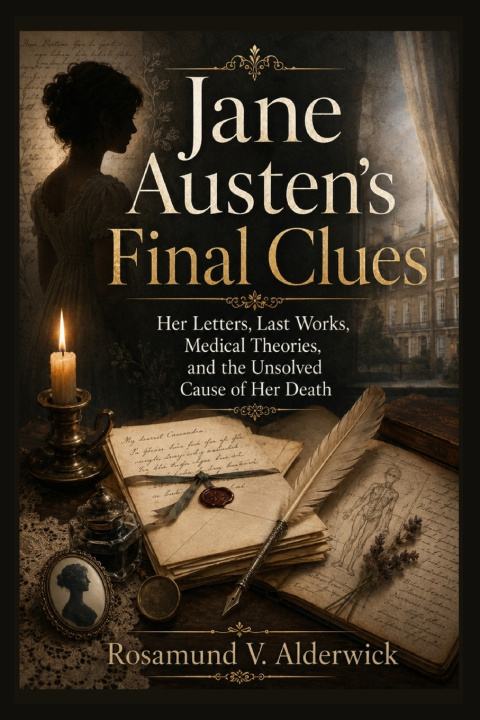
Jane Austen left the world some of literature's most unforgettable characters, yet one question about her own life has never been answered with certainty. On July 18, 1817, she died in Winchester at only forty-one years old after months of pain, weakness, fever, changing health, and brief periods of hope. More than two centuries later, the illness that took her life remains one of literary history's most haunting mysteries.
Her surviving letters contain fragments of a story she never intended to become a medical investigation. A painful back. A troublesome knee. A face described in strange colors. Feverish nights. Temporary recovery. Then renewed decline. Doctors and researchers have searched these clues for answers, proposing Addison's disease, cancer, lymphoma, tuberculosis, and lupus. Yet every theory explains something while leaving another question behind.
Inside, you'll discover
• The gradual decline in Jane Austen's health and the symptoms preserved in her surviving correspondence
• Why her private letters have become central to modern attempts to understand her final illness
• The medical limits of Regency England and what physicians could and could not diagnose in 1816 and 1817
• How the Addison's disease theory became the most familiar explanation for her death
• The arguments surrounding cancer, Hodgkin's lymphoma, tuberculosis, and other competing possibilities
• Why the modern lupus hypothesis has caused researchers to reconsider her joint pain, facial changes, fever, and periods of apparent recovery
• The emotional story of Jane and Cassandra during the final journey from Chawton to Winchester
• The known events surrounding Austen's last weeks at College Street
• How Persuasion and Sanditon reveal a writer deeply attentive to weakness, recovery, invalidism, health anxiety, and the human search for cures
• What surviving hair samples may reveal, and why modern scientific testing has still failed to provide a final answer
This is not a book that forces a diagnosis onto a woman who can no longer answer modern medical questions. It follows the evidence with care, examining what is known, what remains uncertain, and why intelligent researchers can study the same clues and reach very different conclusions.
Beyond the medical mystery is the deeply human story of a brilliant writer whose body was failing while her humor, observation, and emotional intelligence remained alive. Jane Austen's Final Clues invites readers to look closely at her last year, not only to ask what caused her death, but to see the woman behind the famous novels with greater compassion, honesty, and understanding.