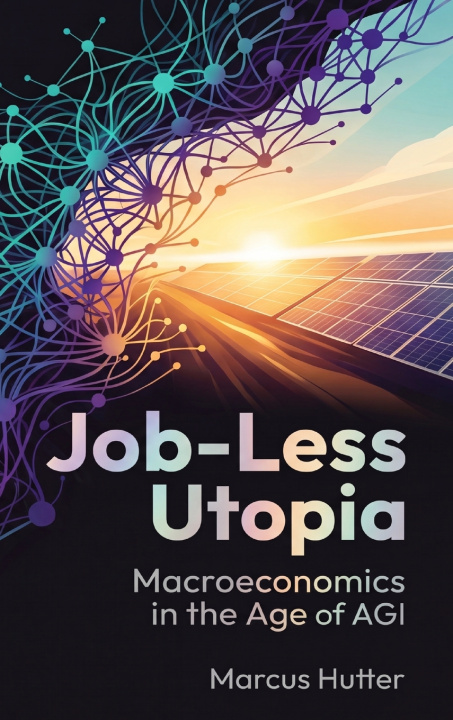
Könyv Job-Less Marcus Hutter

Job-Less

Utopia Macroeconomics in the Age of AGI

Szerző: Marcus Hutter
Nyelv: Angol
Kötés: Kemény kötésű
Kiadó: AIXI Media
Elérhetőség: Beszállítói készleten
Küldés 14-21 napon belül
16 888 Ft
What happens when machines do every job better than you?Artificial general intelligence and advanced...

Információk a könyvről

Szerző
Nyelv
Angol
Kötés
Könyv - Kemény kötésű
Kiadva
2026
oldal
274
EAN
9781066828418
ISBN
1066828415
Enbook ID
53418877
Kiadó
Súly
667
Méretek
152 x 229 x 22

Teljes leírás

What happens when machines do every job better than you?

Artificial general intelligence and advanced robotics will automatevirtually all cognitive and physical tasks within a single generation.The question is not whether this will happen, but what we dowhen it does.

Three dominant responses get it wrong: optimists who trust history torepeat, pessimists who equate job loss with collapse, and skeptics whodeny the technology altogether. All three fixate on jobsrather than goods and services.

Job-Less Utopia argues for a fourth position:Post-Labor Prosperity. If machines produce the same or greateroutput, society's material wealth is undiminished. The real challengeis distribution, not production. Under adequate redistribution, massunemployment is not a catastrophe: it is a liberation.

The book develops this case along thirteen theses spanningsix domains:

  • Economics: Near-zero marginal costs, self-replicatingcapital, and solving the land bottleneck.
  • Employment: Why the historical pattern of compensatingjob creation will break, and why forcing full employment producessocially wasteful bullshit jobs.
  • Welfare design: How multiple complementary tax instrumentscan finance guaranteed income, even cost-neutrally.
  • Democracy: Why functioning democracies will self-correcttoward redistribution as the displaced majority gains electoralpower.
  • Meaning: Why the "crisis of meaning" is a transientcultural artifact, neither a natural nor unresolvable humanlimitation.
  • Geopolitics: How AI rentierism, trade asymmetries, andcapital flight can be managed through proven policy tools.
Why this book is different: Nearly every individual idea herehas appeared before. What is new is the systematicarchitecture: the first single-volume treatment integratingeconomics, welfare design, democratic stability, the question ofmeaning, and international coordination into one mutually reinforcingargument. The book includes a micro-level fiscal-feasibility proof, a Wittgensteinian property-cluster definition of"job," a three-phase UBI transition roadmap with pre-legislatedautomation triggers, and a new tax category: the bullshit tax.Extensively illustrated with 41 diagrams and 30 tables,and grounded in over 250 scholarly references.

Dr. Marcus Hutter is a polymath whose 35-year R&D career hasranged from medical software development to physics, mathematics,computer science, philosophy, and artificial intelligence. Morerecently his work has focused on AGI's economic, political, and socialimplications. He has been Professor at the Australian NationalUniversity for most of his career.