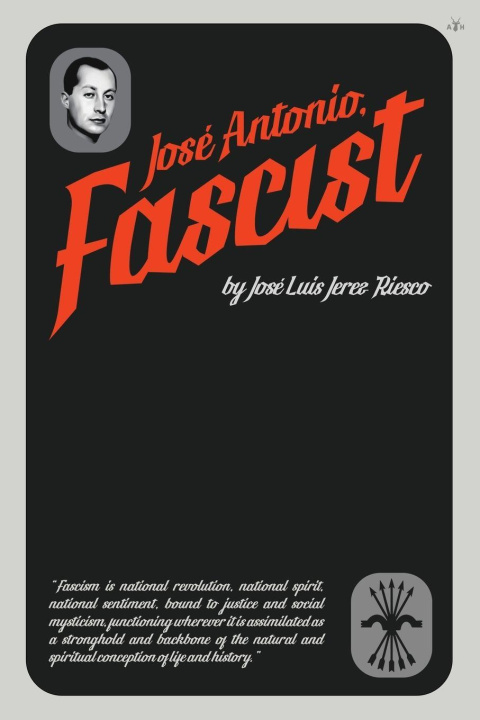
Interwar Spain was a hotbed of political violence and intrigue, marked by the use of state power by liberals and socialists-in open collaboration with communists-in order to ruthlessly suppress right-wing factions. Disgusted by ineffective conservative resistance, a select number of right-wing intellectuals formed the Falange Española (Spanish Phalanx) to preserve the spirit of their nation. The Falangists offered a more populist, youth-oriented, and dynamic approach to politics, with the goal of motivating the people of Spain to action, and replacing the Republic with a form of government that would ennoble the Spanish character amid the stagnation of the postwar years.
Lead by the illustrious José Antonio Primo de Rivera y Sáenz de Heredia (1903-1936), eldest son of former dictator General Primo de Rivera, the Falangists recognized that the situation required a different methodology than the reactionary impulses of the other conservative factions in Spain. Contained within is a detailed history the Falangist movement, including biographies of its leaders and descriptions of its ties to and interactions with other fascist movements in Europe. These primary sources, many of which are here translated into English for the first time, are invaluable to students of Spanish history, or those interested in populist movements of the interwar era. In José Antonio, Fascist, scholar Jose Luis Jerez Riesco demonstrates that Falangism, while inspired by, and complementary to, other contemporary movements like Italian Fascism and German National Socialism, nonetheless possessed a uniquely Spanish identity, including a strong Catholic influence as well as economic syndicalism.
The story of the era is presented in large part through a history of Falangist newspapers and other publications-many of which survived only in the author's private archives-giving the reader the feeling of following the movement as it developed in response to the extreme pressures placed upon it. Through these primary sources as presented by Jerez Riesco, the reader is able to see the Falange on its own terms and understand how it saw itself and its place in history. By tracing the history of Falangist newspapers, the reader can also see how the Falangists responded and adapted to suppression and censorship from the republican government of Spain.
Antelope Hill is proud to make this work available in English for the first time, ensuring that the true history of the Falangist movement is made accessible to the general public.