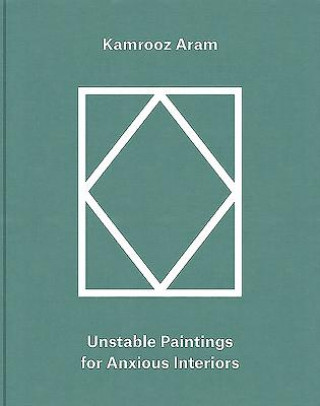
This monograph on Iranian-born, Brooklyn-based painter Kamrooz Aram (b.1978) presents the Palimpsest series, which was in part inspired by graffiti on the streets of New York, and its constant painting-over by the authorities, only for it to become covered again in graffiti. The ongoing cycle of painting, covering-up and repainting in the urban environment connects with Aram s long-standing fascination with modernism and the legacies of Abstract painting.Aram explains: The word palimpsest derives from the Greek term for a manuscript that has been scraped down so it can be reused. However, this process of erasure is always incomplete and traces of previous layers remain visible beneath the most recent marks. I find the idea of painting as palimpsest compelling because such a painting reveals its own past. The concept of the palimpsest in relation to Aram s practice is explored further in the publication in texts by Eva Diaz, Professor of Contemporary Art at Pratt Institute in New York, and art historian and critic Media Farzin.As discussed in an engaging interview between the artist and critic and art historian Murtaza Vali, Aram s interest in painting as palimpsest evolved over years of observing and photographing walls in cities across the world, from Brooklyn and Queens to Beirut and Istanbul. The worn walls of Beirut still bear the scars of the civil war, while in Brooklyn, years of graffiti and its covering-up reveal the history of New York City. This phenomenon takes on a different, but related meaning in a city such as Istanbul, where the graffiti is the result of public demonstrations related directly or otherwise to the Gezi Park protests. Aram states: The graffiti was obviously political and so the state s response was rapid. The protesters would write and the state would cover it up immediately. A photo essay and text by the artist further explore notions of the palimpsest and covering-up.In the Palimpsest series, a floral motif that Aram appropriated from a Persian carpet on sale in a shop in Manhattan becomes a key element in the series, submerging and re-emerging within the many layers of accumulated and erased marks on his canvases. Working serially, the artist begins each painting with this floral form, drawn across the surface of the canvas in a grid, creating an overall pattern. Aram then begins destroying and rebuilding this pattern through a process that involves additive as well as subtractive mark-making: wiping away and scraping down the painted surface over time to reveal previous layers. The relationship between West and East, and more specifically between the United States and the Middle East, has long been a key concern in Aram s life and work. Central to Aram s practice to date is the interface between Middle Eastern traditions of pattern-making, decoration and ornamentation, and the 20th century Western tradition of modernist painting, with geometry often intersecting the two worlds. The mixing of these once diametrically opposed paradigms tells a more complex story in Aram s paintings of interwoven cultures, interconnected politics, and of visual languages that collide, recede and reemerge over time.Kamrooz Aram graduated with an MFA from Columbia University, New York, in 2003. Since then his work has been widely exhibited internationally and featured in publications such as The New York Times, The New Yorker, The Village Voice, Art in America, Artforum.com, ArtAsiaPacific, and Bidoun. Aram was a recipient of the Abraaj Group Art Prize 2014. The publication, illustrated with over fifty plates, photographs, and details, has been edited by Yasmin Atassi, designed by Joe Gilmore / Qubik, printed by Die Keure, Bruges, and co-published by Green Art Gallery, Dubai, and Anomie Publishing, UK."