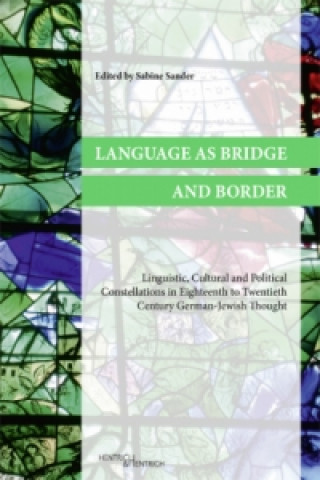
A rich variety of language concepts originated within the German-Jewish context since the Haskala. Many Jewish scholars had multilingual skills, were familiar with traditional Jewish commentary or grew up on the border between different cultures and denominations. In the articles gathered in this volume, language does not emerge as an isolated phenomenon, but develops with reflections on the relation between language and politics, including questions of identity, exclusion and inclusion, language loss and criticism or messianic concepts. Language turns out to be a social fabric that can build bridges and draw borders. Examining the historical and sociocultural background of these concepts allows insights into the structure of human expression, and its bearing on issues facing multicultural societies today.§§With contributions by Chiara Adorisio, Dörte Bischoff, Donatella Di Cesare, Elke Dubbels, Ramona Fändrich, Ilit Ferber, Gerald Hartung, Christine Kirchhoff, Arndt Kremer, Jeannine Kunert, Avi Lifschitz, Leena Petersen, Sabine Sander, Philipp von Wussow