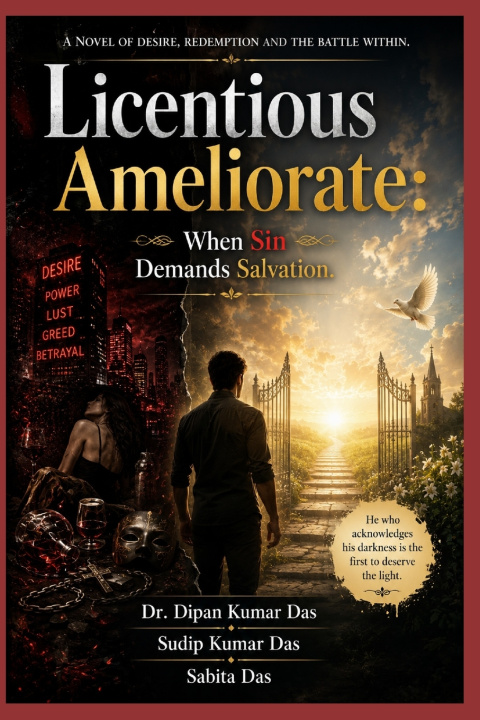
Chapter 1: The Aristocrat of Excess
Jonathan "Johnny" Sain inherited more than a billion-dollar empire. Wealth had insulated him from consequence. Every desire became an order, every temptation a routine, every relationship a transaction. To the public, he was a philanthropist. To those who truly knew him, he was a collector. Not of art. Not of companies. But of broken lives.
Chapter 2: The Psychologist Who Counted DarknessDr. Dipanshu never believed evil was born. He believed it accumulated. Over twenty years he had interviewed more than one hundred individuals whose lives revolved around obsession, manipulation, addiction, domination, compulsive desire, and moral collapse. His office walls displayed no degrees. Only clocks. Each frozen at different times. Visitors always asked why. His answer never changed. "Trauma stops time." His life's work became a rehabilitation system called AMELIORATE. It rejected punishment. It rejected medication as the sole answer. It rejected confession without understanding. Instead, it reconstructed identity through neuroscience, philosophy, behavioral conditioning, memory reconstruction, moral reasoning, and radical honesty.
Chapter 3: The First SessionAMELIORATE began with an unusual instruction. "No lies." Johnny smiled. "Everyone lies." Dipanshu replied quietly. "Not everyone lies to themselves." The interview lasted twelve hours. Questions moved from childhood to business. From love to violence. From ambition to guilt. Every biometric sensor indicated Johnny remained emotionally stable. Until Dipanshu asked only one question. "Who is Sinu?" Johnny's pulse doubled. His pupils widened.
He answered... "I've never heard that name."
Chapter 4: SinuSinu grew up believing kindness was not weakness but discipline. She worked with victims recovering from psychological abuse. Unlike everyone else, she never feared wealthy men. She pitied them. Years earlier she had met Johnny during a charity event. He expected admiration. She offered criticism.
"You have everything except peace." Johnny laughed. "No one buys peace." Sinu answered, "Exactly."
Chapter 5: The Architecture of DesireDipanshu introduced Johnny to the Seven Mirrors.
Each mirror represented one psychological illusion:
Power, Lust, Greed, Control, Vanity, Fear, Loneliness
Johnny insisted he had conquered every one. Dipanshu corrected him. "They conquered you."
Chapter 6: The Missing YearsHypnosis was forbidden. Suggestion was forbidden. Only documented memory reconstruction was allowed. Fragments emerged. A private island. Political bribery. Corporate sabotage. Disappearances. Hidden charities. Unknown benefactors. Some memories portrayed Johnny as a monster.
Chapter 7: The Crime Without a KillerAn unsolved case involving several unexplained deaths resurfaced. Every trail pointed toward Johnny. Every piece of evidence collapsed under scrutiny.
Chapter 8: The Woman Who Refused to HateSinu returned unexpectedly. She agreed to participate as an independent observer. She neither defended nor condemned Johnny. Instead she challenged every excuse he made. "You confuse freedom with permission." "You confuse desire with identity." "You confuse guilt with punishment."
Chapter 9: Love Against AddictionJohnny mistook gratitude for love. Sinu recognized the difference. She refused romance born from dependency. "If you love me only because I saved you," she said, "you are still imprisoned."
Chapter 10: The Experiment Turns on Its Creator
Chapter 11: The Trial of TruthThe courtroom transformed into a philosophical battlefield. Can a criminal truly become another person? If identity changes completely, should society continue punishing the former self? Does justice belong to memory...or to action?
Chapter 12: When Sin Demands Salvation