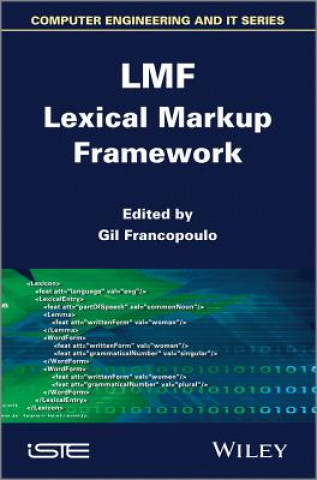
The community responsible for developing lexicons for Natural Language Processing (NLP) and Machine Readable Dictionaries (MRDs) started their ISO standardization activities in 2003. These activities resulted in the ISO standard - Lexical Markup Framework (LMF).§After selecting and defining a common terminology, the LMF team had to identify the common notions shared by all lexicons in order to specify a common skeleton (called the core model) and understand the various requirements coming from different groups of users.§The goals of LMF are to provide a common model for the creation and use of lexical resources, to manage the exchange of data between and among these resources, and to enable the merging of a large number of individual electronic resources to form extensive global electronic resources.§The various types of individual instantiations of LMF can include monolingual, bilingual or multilingual lexical resources. The same specifications can be used for small and large lexicons, both simple and complex, as well as for both written and spoken lexical representations. The descriptions range from morphology, syntax and computational semantics to computer-assisted translation. The languages covered are not restricted to European languages, but apply to all natural languages.§The LMF specification is now a success and numerous lexicon managers currently use LMF in different languages and contexts.§This book starts with the historical context of LMF, before providing an overview of the LMF model and the Data Category Registry, which provides a flexible means for applying constants like /grammatical gender/ in a variety of different settings. It then presents concrete applications and experiments on real data, which are important for developers who want to learn about the use of LMF.§Contents§1. LMF - Historical Context and Perspectives, Nicoletta Calzolari, Monica Monachini and Claudia Soria.§2. Model Description, Gil Francopoulo and Monte George.§3. LMF and the Data Category Registry: Principles and Application, Menzo Windhouwer and Sue Ellen Wright.§4. Wordnet-LMF: A Standard Representation for Multilingual Wordnets, Piek Vossen, Claudia Soria and Monica Monachini.§5. Prolmf: A Multilingual Dictionary of Proper Names and their Relations, Denis Maurel, Béatrice Bouchou-Markhoff.§6. LMF for Arabic, Aida Khemakhem, Bilel Gargouri, Kais Haddar and Abdelmajid Ben Hamadou.§7. LMF for a Selection of African Languages, Chantal Enguehard and Mathieu Mangeot.§8. LMF and its Implementation in Some Asian Languages, Takenobu Tokunaga, Sophia Y.M. Lee, Virach Sornlertlamvanich, Kiyoaki Shirai, Shu-Kai Hsieh and Chu-Ren Huang.§9. DUELME: Dutch Electronic Lexicon of Multiword Expressions, Jan Odijk.§10. UBY-LMF - Exploring the Boundaries of Language-Independent Lexicon Models, Judith Eckle-Kohler, Iryna Gurevych, Silvana Hartmann, Michael Matuschek and Christian M. Meyer.§11. Conversion of Lexicon-Grammar Tables to LMF: Application to French, Éric Laporte, Elsa Tolone and Matthieu Constant.§12. Collaborative Tools: From Wiktionary to LMF, for Synchronic and Diachronic Language Data, Thierry Declerck, Pirsoka Lendvai and Karlheinz Mörth.§13. LMF Experiments on Format Conversions for Resource Merging: Converters and Problems, Marta Villegas, Muntsa Padró and Núria Bel.§14. LMF as a Foundation for Servicized Lexical Resources, Yoshihiko Hayashi, Monica Monachini, Bora Savas, Claudia Soria and Nicoletta Calzolari.§15. Creating a Serialization of LMF: The Experience of the RELISH Project, Menzo Windhouwer, Justin Petro, Irina Nevskaya, Sebastian Drude, Helen Aristar-Dry and Jost Gippert.§16. Global Atlas: Proper Nouns, From Wikipedia to LMF, Gil Francopoulo, Frédéric Marcoul, David Causse and Grégory Piparo.§17. LMF in U.S. Government Language Resource Management, Monte George.§About the Authors§Gil Francopoulo works for Tagmatica (www.tagmatica.com), a company specializing in software development in the field