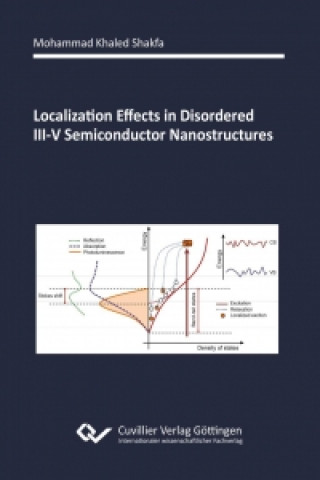
Due to the increasing demands industrially as well as scientifically on new optoelectronic devices for specific applications, semiconductor materials with desired energy band-gap are needed. In this context, alloying provides the ability to tailor the energy band gap of a compound semiconductor (ternary or quaternary) through the manipulation of its constituent composition. In this thesis, It is focused on two different III-V-based compound semiconductor materials, Ga(NAsP) and Ga(AsBi), both are promising for long-wavelength optoelectronic applications. In particular, quaternary Ga(NAsP) semiconductor structures can be utilized for the fabrication of intermediate band solar cells, for infrared laser emission, and, with a tremendous potential, for the realization of monolithic optoelectronic integrated circuits on silicon substrate (silicon photonics). On the other hand, ternary Ga(AsBi) semiconductor structures have been employed for a variety of applications including, for example, but not limited to, photoconductive terahertz antennas, light-emitting diodes (LEDs), and optically pumped as well as electrically injected laser diodes.
Band gap engineering is achieved in the studied GaAs-based compounds by varying the amount of the incorporated V-element, i.e., nitrogen or bismuth. Despite the advantage of a shrinking in the band-gap energy, the introduction of a small amount of a V-element to a GaAs host structure results in an increase in the disorder potential due to the differences, e.g., in size and electronegativity between the incorporated and substituted anions. The presence of disorder effects within a semiconductor can significantly influence its electronic structure, i.e., the density of localized states (DOS) is increased. Disorder-induced localized states drastically affect carrier recombination processes in semiconductors. The changes in carrier dynamics can be revealed by investigating, e.g., electrical and optical properties of disordered semiconductors. In the presented work, photoluminescence (PL) spectroscopy measurements are employed for the characterization of disorder in semiconductor nanostructures. Beside the need of a qualitative explanation, a quantitative description of disorder effects, i.e., energy scaling of the disorder potential, is a task of crucial importance. Both aspects are discussed through the thesis.