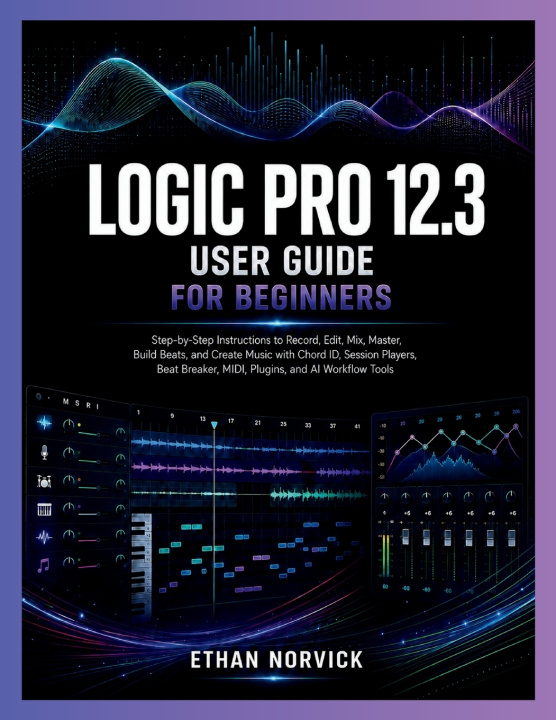
Are you ready to create music, record vocals, build beats, edit audio, mix tracks, and export finished songs using Logic Pro 12.3, but you feel overwhelmed by all the buttons, tools, plugins, and settings?
Logic Pro 12.3 User Guide for Beginners is a practical, step-by-step user guide book created to help beginners understand Logic Pro in a simple, clear, and educational way. Instead of confusing you with unnecessary technical language, this guide walks you through the real workflow of music production, from opening your first project to recording, editing, arranging, mixing, mastering, troubleshooting, and exporting your finished track.
Inside this book, you will learn how to set up Logic Pro correctly, connect microphones and audio interfaces, record vocals and instruments, work with MIDI and software instruments, build beats, use Drum Machine Designer and Step Sequencer, understand Chord ID, create backing performances with Session Players, use Beat Breaker, apply plugins, clean up recordings, arrange a complete song, mix with EQ, compression, reverb, and delay, master your track, and share your music with confidence.
Whether you are a singer, rapper, producer, beat maker, songwriter, podcaster, voice-over artist, content creator, or home studio beginner, this guide gives you the foundation you need to stop guessing and start creating. You do not need to be a professional musician or sound engineer before using this book. You only need the desire to learn and practice.
This book will help you:
- Understand the Logic Pro 12.3 workspace without feeling lost
- Set up audio input, output, sample rate, and buffer size correctly
- Record vocals, instruments, and MIDI with better confidence
- Build beats, chords, basslines, melodies, and full song ideas
- Use Chord ID, Session Players, Beat Breaker, Alchemy, plugins, and AI workflow tools
- Edit audio and MIDI without damaging your project
- Arrange, mix, master, export, and back up your music properly
- Troubleshoot common beginner problems like no sound, latency, crackling audio, and plugin issues
If you want a beginner-friendly guide that helps you move from confusion to confidence in Logic Pro 12.3, this book is designed for you.
Start learning today and take your first step toward creating, producing, and finishing music with Logic Pro 12.3.
This is an independent user guide book created for educational and informational purposes only. It is not an official manual, publication, or product of Apple Inc., and it is not affiliated with, endorsed by, sponsored by, or connected to Apple Inc. All product names, trademarks, and features mentioned are used strictly for identification, explanation, and educational purposes.