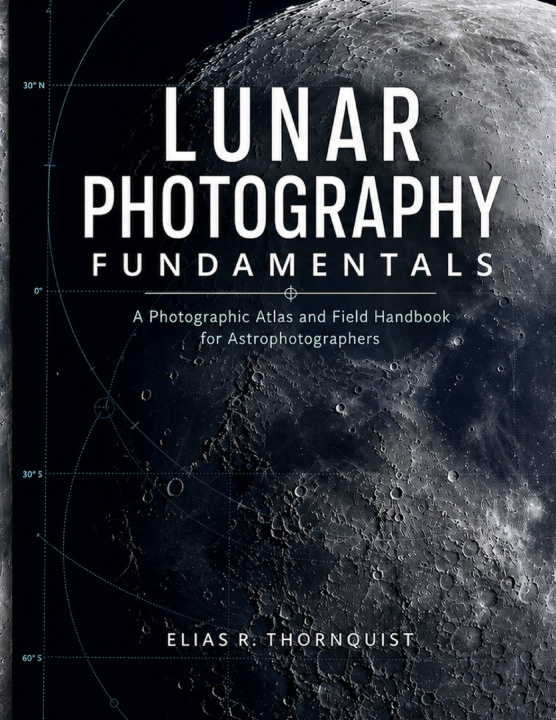
Most photographs of the Moon fail for the same reason: they're taken on the wrong night, at the wrong exposure, without understanding why the Moon behaves so differently from every other subject a camera ever points at. The result is a flat, overexposed white disk with none of the crater detail, shadow relief, or texture that a modest telephoto lens or small telescope is fully capable of capturing.
The real difficulty isn't the equipment. It's that the information a photographer actually needs - when the terminator will cross a given region, how to expose correctly for a subject far brighter than most night-sky targets, how focal length translates into pixels on a sensor, and how to see past atmospheric turbulence - is usually scattered across equipment reviews, forum threads, and one-off tutorials that never connect into a complete method.
This book supplies that method, and then keeps working as a reference long after the technique is learned. It opens with the geometry that governs everything else - phases, the terminator, libration, and apparent size - and how each determines what is actually visible on a given night. From there it builds through optics, camera, and mount selection; exposure theory backed by worked numerical examples; and capture technique designed around atmospheric turbulence rather than in spite of it. A complete processing workflow follows - stacking, sharpening, and tonal and color adjustment - and the book then becomes a genuine photographic atlas, organizing lunar terrain region by region across the eastern, central, and western portions of the visible disk, by the day of the lunar cycle on which each area is best photographed.
Readers will come away able to:
- Predict which lunar regions show maximum shadow detail on any given night
- Choose optics, a camera, and a mount suited to their goals, understanding the real resolution limits involved
- Set exposure correctly for the Moon's brightness using quick-reference tables and worked examples
- Capture sharp images despite atmospheric turbulence, including high-frame-rate techniques
- Stack, sharpen, and color-correct raw captures into a finished image
- Identify named craters, maria, rilles, and ray systems using a structured, night-by-night atlas
- Plan, log, and troubleshoot real sessions with field-ready checklists, a target calendar, and a symptom-based diagnostic table
The book covers lunar phase and terminator geometry, optics and camera selection, mounts and tracking, exposure theory, capture technique, image stacking and processing, surface-feature identification, and a complete regional atlas, closing with a field handbook, a hundred-target photography challenge, and a glossary.
It is written for photography enthusiasts and amateur astronomers at any starting point - from a first session with a camera and tripod through telescope-based imaging with dedicated tracking and processing - who want one structured resource carrying them from a first frustrating attempt to consistent, detailed, well-identified lunar images.
Open the book and begin building the understanding needed to turn your next clear night into a sharp, well-planned lunar photograph.