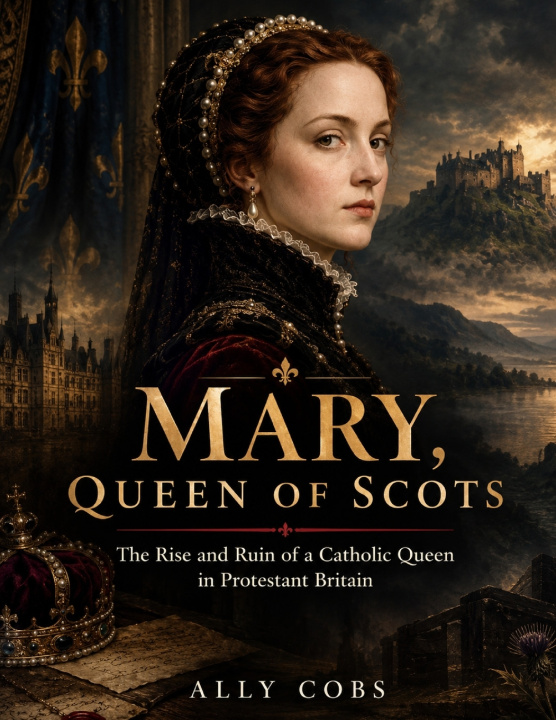
On the 8th of February 1587, a former Queen of Scotland knelt before an executioner at Fotheringhay Castle and spoke her final words in Latin, a defiant declaration of Catholic faith before a Protestant government about to take her life.
Mary Stuart was crowned Queen of Scotland when she was six days old. She grew up at the glittering French royal court, briefly became Queen Consort of France by the age of sixteen, and returned to Scotland as a young widow to rule a kingdom that had transformed into a Protestant nation during her thirteen years abroad. What followed was one of the most turbulent reigns in British history: a controversial marriage, a secretary murdered before her eyes, a husband killed in a still unsolved conspiracy, a forced abdication, and a desperate escape that ended not in freedom but in nearly two decades of captivity in England.
This book traces Mary's extraordinary life from her infant coronation through her execution, following the political and religious conflicts that shaped sixteenth century Britain and Europe. Readers will follow her childhood in France, her contested rule in Scotland, her disputed involvement in the murder of Lord Darnley, and the long imprisonment during which conspiracy after conspiracy gathered around her, culminating in the Babington Plot that finally sealed her fate.
Mary's story is inseparable from the larger forces that defined her era: the Protestant Reformation reshaping three kingdoms, the rivalry between Catholic and Protestant Europe, and the complicated relationship between two royal cousins, Mary and Elizabeth I, who never met in person yet spent decades shaping each other's fortunes. Readers will come away with a clear understanding of how religious conflict, dynastic ambition, and personal choice collided to produce one of history's most compelling and contested lives.
Was Mary a tragic figure caught in circumstances beyond her control, or a woman whose own choices contributed to her downfall? This book presents the full historical record and lets readers weigh the evidence for themselves, offering not just the story of a queen who lost her head, but genuine insight into the people, decisions, and consequences that shaped an entire era of British and European history.
For readers who want a clear, engaging, and historically grounded account of one of the sixteenth century's most remarkable lives, Mary's story begins here.