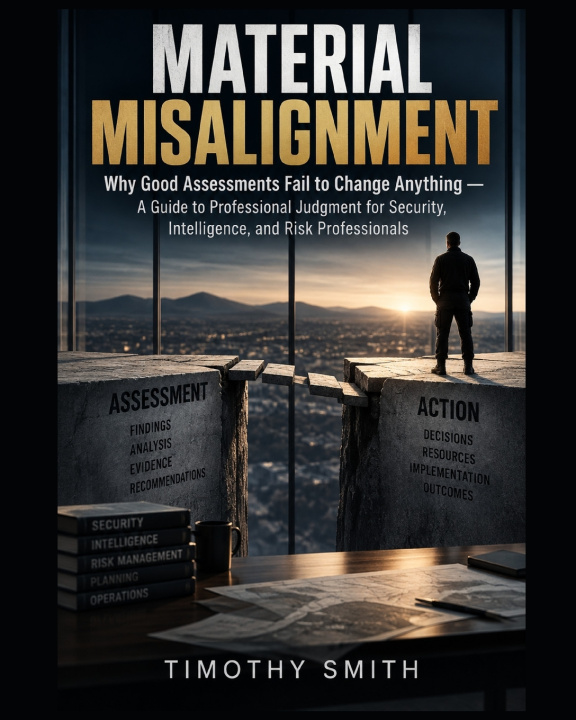
You identified the risk. You documented the evidence. You delivered the assessment. Why hasn't anything changed?
A security assessment can be accurate while the vulnerability remains. An intelligence warning can be understood while operations continue unchanged. A corrective action can be marked complete without improving the organization's ability to respond. Sometimes nothing happens. Sometimes leadership acts immediately-and solves the wrong problem.
Material Misalignment examines the gap between understanding a problem and making a defensible decision about it.
Written for security, intelligence, and risk professionals, this guide addresses the responsibility that begins where the report ends. It explores what happens when evidence meets limited resources, unclear authority, competing priorities, organizational pressure, and a decision window that will not stay open forever.
At its center is a consequential problem: the organization's understanding, assumptions, and plans no longer match actual conditions closely enough to justify continuing without review. The procedures may still be followed. The reports may still arrive. The organization may look prepared while becoming increasingly vulnerable.
Through practical explanations and illustrative scenarios, Timothy Smith explores how to:
- Separate evidence from assumption. Distinguish facts, reports, inferences, and unknowns without turning confidence into false certainty.
- Frame the decision that actually matters. Clarify the objective, identify who has authority, and prevent a preferred solution from defining the problem.
- Choose a proportionate response. Weigh action, restraint, escalation, and temporary measures against consequences, available capability, and the cost of delay.
- Recognize when the plan no longer fits. Examine contradictory reporting, recurring workarounds, failing controls, and the indicators that should trigger reassessment.
- Learn without rewriting history. Distinguish decision quality from outcome quality, evaluate implementation, and turn findings into meaningful corrective action.
Applications span physical security and facility risk, intelligence and protective decisions, crisis management, emergency response, and business continuity. Three practical appendices provide a decision framework, a professional decision record, and guidance for decision review and after-action analysis.
This is not an argument for always acting faster, purchasing more equipment, or adding another layer of procedure. It is a guide to selecting the most defensible next action-including when to wait, when to intervene, and when to change direction-without exhausting the resources needed for the next problem.
For practitioners who advise, supervisors who implement, and leaders who must own the consequences, Material Misalignment moves beyond documenting what is wrong to examining what responsible judgment requires next.
Assessment identifies the condition. Professional judgment determines the response.