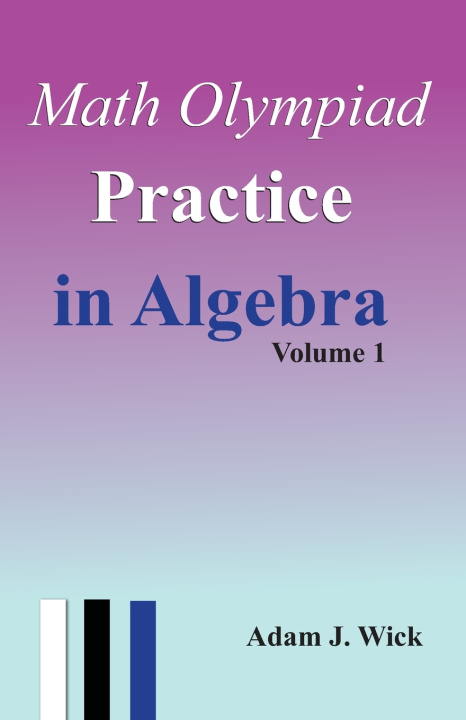
This book, Math Olympiad Practice in Algebra Volume 1, is written as an introductory collection of carefully selected problems and fully detailed solutions aimed at developing strong algebraic problem-solving skills for mathematical competitions.
The material is organized into seven core chapters:
- Algebraic Manipulation
- Vieta's Theorem
- Square is Positive
- Diophantine Equation
- Real-Valued Function
- Telescoping Sum
- Integer Parts
These topics form the foundation of algebra in olympiad mathematics. Each chapter is designed to introduce essential techniques progressively, starting from fundamental algebraic skills and moving toward more advanced problem-solving strategies.
Rather than focusing only on obtaining final answers, the emphasis of this book is on understanding why methods work. Detailed step-by-step solutions are provided to highlight key ideas such as factorization techniques, symmetry arguments, inequality reasoning, functional decomposition, telescoping structures, and number-theoretic analysis. Readers are encouraged to study the logic behind each solution carefully and to attempt every problem before reading the full explanation.
The chapter on algebraic manipulation builds fluency in transforming expressions efficiently. Vieta's Theorem introduces the deep connection between roots and coefficients of polynomials. The section on "Square is Positive" develops inequality intuition through basic but powerful observations. Diophantine equations strengthen number theory thinking in algebraic settings. Real-valued functions introduce functional reasoning and optimization techniques. Telescoping sums demonstrate elegant simplification of complex expressions, while integer parts develop precision in handling floor functions and discrete structure.
This volume is intended for students who are beginning olympiad-level algebra, as well as those who wish to strengthen their foundation before moving on to more advanced topics. The problems are chosen to gradually build confidence, intuition, and mathematical maturity.
It is hoped that this book will not only serve as a training resource, but also help readers appreciate the elegance and creativity of algebra. Success in problem solving comes not from memorizing formulas, but from learning to recognize structure, make insightful transformations, and think flexibly.